The Diffuser Guide: Choosing, Using and Not Overdoing It
Quick Answer: Use 3–5 drops of essential oil per 100ml of water in an ultrasonic diffuser, and run it in 30–60 minute intervals rather than continuously — your nose stops registering a scent within minutes anyway, so more oil and longer runtime give you exposure without benefit. Never diffuse in a room a cat can’t leave; cats lack the liver enzyme needed to process many essential oil compounds.
The diffuser became the modern candle: on every shelf, running all day, chosen almost entirely by how it looks next to the plant.
Which is fine, except the types genuinely differ, the dosing matters more than anyone practices, and “more mist” is not “more benefit.” Here’s the owner’s manual that didn’t come in the box.
Which Type of Diffuser Should You Buy?
| Type | How it works | Scent strength | Oil use | Best for |
|---|---|---|---|---|
| Ultrasonic | Water + oil vibrated into cool mist | Gentle–moderate | Low | Most homes |
| Nebulizing | Pure oil atomized, no water | Strong | High | Large rooms, enthusiasts |
| Reed | Passive wicking, no power | Constant, mild | Moderate | Hallways, bathrooms |
| Heat-based | Warms oil to release scent | Moderate | Low | Rarely recommended |
Ultrasonic is the right default for most people. It adds a little humidity as a side effect (welcome in winter, less so in a damp room), the scent is gentle, and cleaning is straightforward. Expect $20–50.
Nebulizing diffusers atomize pure oil with no water, producing a much stronger scent and preserving the oil’s chemistry completely. The trade-offs: they burn through oil fast (a 15ml bottle can disappear in a couple of weeks), they’re louder, and they cost $80–150. Worth it if you’re scenting a large open space or you’re serious about aromatherapy.
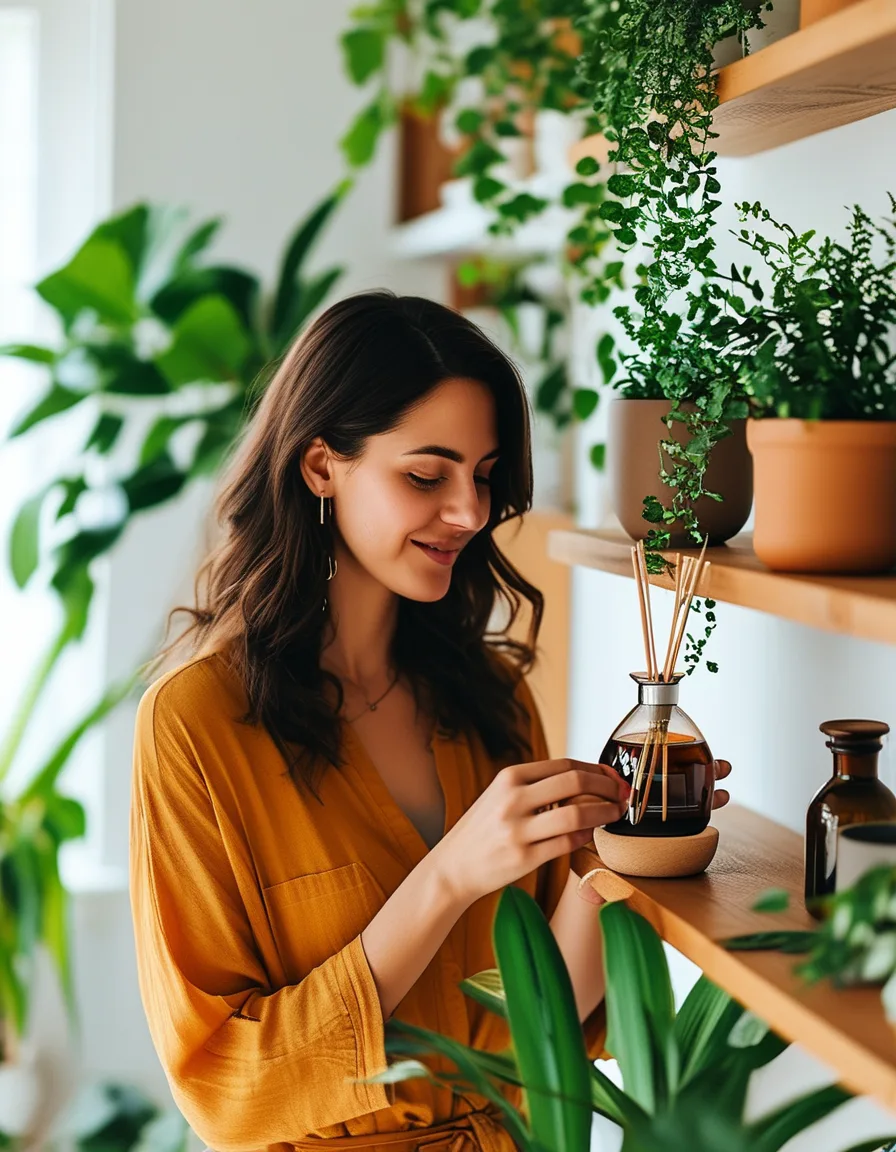
Reed diffusers need no power and run continuously, which makes them ideal for a hallway or a small bathroom. Flip the reeds weekly to refresh the scent.
Heat-based — candle warmers and plug-ins — alter the oil’s chemistry through heat, which changes the aromatic profile and, for anyone using oils for a specific purpose, defeats much of the point. Fine for pleasant smell, not for aromatherapy.
How Many Drops of Essential Oil Should You Use?
3–5 drops per 100ml of water. A standard 300ml ultrasonic diffuser takes 9–15 drops maximum.
Most people use double that, and here’s why it accomplishes nothing: olfactory adaptation. Your nose stops registering a constant scent within roughly 5–15 minutes. So the person who doubles the dose gets exactly the same perceived scent after fifteen minutes as the person who didn’t — while doubling everyone’s exposure and burning through oil twice as fast.
Run it in intervals, not marathons. 30–60 minutes on, then off for an hour or two. Most decent diffusers have an intermittent mode that nobody activates. Intermittent running keeps the scent perceptible (because your nose resets during the off period) and keeps total exposure sensible.
Ventilate. Diffusing in a sealed room all day is, functionally, fragrance hotboxing. Crack a window or a door.
Clean it weekly. Empty the reservoir, wipe with a cloth and a little vinegar or rubbing alcohol, rinse. Oil residue builds up, goes rancid, and mixes with whatever you diffuse next — which is why old diffusers often smell faintly wrong.
The Safety Fine Print
Pets change the math entirely — especially cats.
Cats lack the liver enzyme (glucuronyl transferase) needed to metabolize many of the phenols and terpenes in essential oils, which means compounds that clear a human’s system readily can accumulate in a cat’s. Diffused oils also settle on fur and get ingested during grooming.
The practical rules:
- Diffuse only in rooms a pet can freely leave
- Never diffuse in a room where a cat sleeps, eats, or is confined
- Tea tree, wintergreen, pine, citrus oils, ylang-ylang, peppermint, and eucalyptus are among those most frequently flagged as problematic for cats
- Birds are even more sensitive — their respiratory systems are extraordinarily efficient, and diffusing near birds is generally advised against entirely
- Dogs are more tolerant than cats but not immune
If you have pets, a vet-informed list for your specific animals is worth ten minutes of searching.
Pregnancy, infants, and children warrant conservative choices and professional guidance. Several oils are commonly advised against during pregnancy, and infants under six months are generally best kept away from diffused oils entirely.
Asthma and fragrance sensitivity deserve a trial-small-first approach. Diffused oils can trigger respiratory symptoms in sensitive people, and a household member who gets a headache from your diffuser isn’t being difficult.
Quality matters. Look for pure single oils from brands that publish GC/MS testing. “Fragrance oil” is a synthetic product sold on the same shelf — perfectly fine for smelling nice, entirely different from an essential oil.
Scenting Room by Room
The meta-rule: one scent identity per room beats a house-wide fog. Noses appreciate geography — walking from one scent into another is pleasant, while a single smell everywhere just becomes invisible.
Bedroom — calm. Lavender, chamomile, cedarwood, bergamot. Run it for 30 minutes before bed and switch it off when you get in. The scent has done its wind-down job by then, and sleeping in a running diffuser is unnecessary exposure plus, in an ultrasonic, unwanted humidity.
Workspace — alert. Rosemary, peppermint, lemon. The research on scent and cognitive performance is small and mixed, but the effect is pleasant regardless. Run it for the first 30 minutes of a work block.
Living room — crowd-pleasers. Sweet orange, grapefruit, cedarwood, a touch of frankincense. Citrus is the most universally liked and the least likely to bother a guest.
Bathroom — eucalyptus. The shower-steam pairing is the home-spa classic and it genuinely works, because steam carries the aromatic compounds. A reed diffuser suits a bathroom better than an ultrasonic, given the existing humidity.
Kitchen — go easy or skip. Food smells and diffused oils compete, and the oils usually lose. Lemon is the one that plays nicely.
5 Mistakes Everyone Makes
- Overdosing. Fifteen drops in a 300ml diffuser is the maximum, not the starting point. Your nose adapts within minutes regardless.
- Running it all day. Intervals, not marathons. Both for scent perception and for sensible exposure.
- Never cleaning it. Weekly, with vinegar or alcohol. Rancid oil residue is why old diffusers smell off.
- Using tap water in hard-water areas. Mineral scale clogs the ultrasonic disc and shortens the device’s life considerably. Filtered or distilled water solves it.
- Diffusing around cats without checking. The most consequential mistake on this list, and the most common — most people simply don’t know cats process these compounds differently.
Mini FAQ
How many drops of essential oil per 100ml of water?
Three to five drops per 100ml. A standard 300ml diffuser takes 9–15 drops. Using more doesn’t make the scent last longer or work better — olfactory adaptation means you stop perceiving a constant scent within 5–15 minutes regardless of concentration.
Can you leave a diffuser on all night?
It’s not recommended. Run it for 30–60 minutes before sleep and switch it off. Continuous overnight diffusion means several hours of unnecessary exposure, and with ultrasonic models it adds humidity that can encourage mold in a closed bedroom. Most diffusers have a timer — use it.
Are essential oil diffusers safe for cats?
Only with real care. Cats lack a liver enzyme needed to process many essential oil compounds, and oils also settle on fur and get ingested during grooming. Diffuse only in rooms your cat can freely leave, never where they sleep or eat, and check specific oils against a vet-informed list. Birds should not be exposed at all.
TL;DR
- Ultrasonic is the right default for most homes. Nebulizing for strength, reed for hallways, skip heat-based.
- 3–5 drops per 100ml. More does nothing — your nose adapts in minutes.
- Intervals, not marathons. 30–60 minutes on, then off.
- Clean weekly with vinegar or alcohol; use filtered water in hard-water areas.
- Pets veto. Cats especially — diffuse only in rooms they can leave, never where they sleep.
- One scent per room. Calm in the bedroom, citrus in the living room, eucalyptus in the bathroom.
A diffuser is a seasoning tool, not a sprinkler system. Dose it the way you’d salt a dish.
Keep Reading
This article is for general informational purposes only and is not medical advice. Always consult a qualified health professional for guidance specific to you.