Why Your Favorite Scent Stops Working After Two Weeks
Quick Answer: Olfactory receptors adapt to a constant stimulus within minutes - a process called olfactory adaptation - so a scent you are continuously exposed to genuinely stops registering. The fix is rotation and intermittency, not a stronger product. Use a scent for a defined purpose in a defined window, switch every one to two weeks, and give your nose gaps. Scents tied to a specific activity also work better than ambient ones, because the association is doing as much work as the molecule.
The lavender that made bedtime feel different for the first ten days now smells like nothing. You did not build a tolerance in any meaningful sense. Your receptors stopped reporting something that never changes.

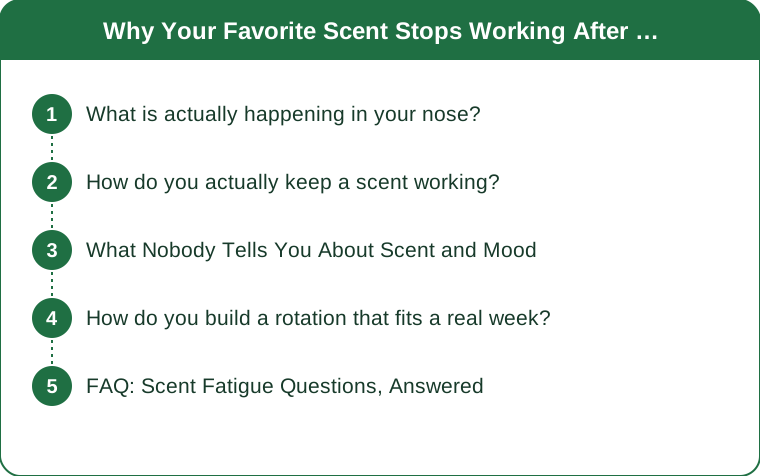
What is actually happening in your nose?
Olfactory receptors reduce their response to a constant stimulus. This is adaptation, and it happens fast - meaningful reduction within a few minutes of continuous exposure, and near-complete within 15 to 20 minutes for many odors. It is a feature, not a fault: the system is built to detect change, because change is what carries information.
Which is why you cannot smell your own home. Constant exposure means constant adaptation. Visitors smell your house because their receptors have not adapted to it, and you smell theirs for the same reason.
Longer-term habituation stacks on top. Beyond minute-to-minute receptor adaptation, repeated daily exposure over weeks reduces how much attention the brain allocates to a familiar smell even when receptors do respond. This is the two-week effect specifically.
Concentration is not the answer. Increasing the intensity produces a brief renewed response and then adaptation at the higher level, which is how people end up with candles and diffusers that are overwhelming to everyone else and unremarkable to them.
And it recovers quickly with a gap. Twenty to thirty minutes away from a smell restores much of the response. A weekend away restores nearly all of it - which is why coming home after a trip is the one moment you smell your own house.
How do you actually keep a scent working?
Rotate on a one to two week cycle. Two or three scents in rotation, switched weekly, keeps each one novel enough to register. This is the single most effective change and it costs nothing beyond owning more than one thing.
Use it intermittently rather than continuously. A diffuser running all day guarantees adaptation. Fifteen to thirty minutes at a specific time - the start of a wind-down, the beginning of focused work - keeps it perceptible and gives it a job.
Attach it to an activity, not to a room. Scent-linked associations form readily, and a smell used only during one activity becomes a cue for that activity. Lavender used only in the 30 minutes before bed does something an all-day lavender diffuser cannot.
Pick contrasting families for the rotation. Citrus, herbal, woody, floral. Rotating between two scents in the same family gives your receptors less of a change than rotating across families.
Give yourself a gap before you want to notice it. If a scent matters for a specific moment, do not be in the room with it for the preceding hour. Twenty minutes away is usually enough to restore most of the response.

What Nobody Tells You About Scent and Mood
Association usually outweighs pharmacology. Much of the mood effect people attribute to specific essential oils appears to be driven by learned association and by expectation. That is not a debunking - a reliable cue that signals wind-down is genuinely useful. It just means the specific oil matters less than the consistency of its use.
Peppermint and citrus are the most commonly reported alerting scents; lavender the most commonly reported calming one. The research is mixed and effect sizes are generally modest, but preference matters more than the literature here. A scent you dislike will not relax you regardless of what a study says.
Scent is unusually good at retrieving memory. Olfactory input reaches the limbic system through a notably direct pathway, which is why smells trigger vivid autobiographical memory more readily than sounds or images. This is worth using deliberately - a scent used only during one season becomes a marker for it.
Adaptation is why perfume seems to fade on you and not on others. Your perfume is almost certainly still detectable to everyone around you long after you stop noticing it. Reapplying because you cannot smell it is the single most common over-application mistake.
Heat, humidity, and airflow change everything. Warm air carries volatile molecules more readily, so a scent that was perfect in a cool room in April is often too much in a warm one in August. Late-summer over-scenting is extremely common and almost always a temperature effect rather than a product change.
And sleep and illness alter perception. Congestion, poor sleep, and hormonal shifts all change smell perception measurably. If a familiar scent suddenly seems wrong, the change may be in you rather than in the bottle.
How do you build a rotation that fits a real week?
Three scents, three purposes. One for focused work, one for movement or energy, one for wind-down. Keep them in different rooms or different forms so they do not blur.
Match the form to the duration. A candle for a defined evening window, a rollerball for a two-minute reset, a diffuser only on a timer. The delivery method controls the exposure length, which is the variable that matters.
Switch the wind-down scent every two weeks and keep the other two stable. The wind-down one is the one whose effect you most want to preserve, so it gets the rotation. Work and movement scents can be more constant because you are entering the room fresh each time anyway.
Shift the family with the season deliberately. Late summer to autumn is a natural switching point - moving from citrus and green to warmer woody and spiced notes in September gives you a full reset and matches the light and temperature changing anyway.
Sniff coffee beans or your own sleeve to reset between scents. Smelling something neutral and familiar helps recalibrate when you are comparing options, which is why perfume counters keep beans out.
And use less than you think in warm weather. Two-thirds of your winter amount is usually right for August, and the room will smell more like the scent to everyone else, not less.
Essential oils can irritate skin and airways, are not safe for all pets - cats in particular - and should be used with caution in pregnancy and around young children. Never apply undiluted oils to skin. This is general information, not medical advice.
FAQ: Scent Fatigue Questions, Answered
Why can I not smell my own perfume anymore?
Olfactory receptors adapt to a constant stimulus within minutes, so a scent on your own skin stops registering while remaining clearly detectable to everyone else. Reapplying because you cannot smell it is the most common cause of over-application.
How often should I change my candle or diffuser scent?
Every one to two weeks, rotating across contrasting scent families rather than between similar ones. Continuous use of a single scent produces both minute-to-minute receptor adaptation and longer-term habituation over weeks.
Does lavender actually help you sleep?
Evidence is mixed and effect sizes are generally modest, and much of the benefit appears to come from learned association and consistent use rather than from the compound itself. A scent used only in the 30 minutes before bed becomes a genuine cue regardless.
Why does my house smell different when I come back from a trip?
Time away lets your olfactory receptors recover from adaptation, so you briefly perceive your own home the way a visitor does. The effect fades within minutes as adaptation reestablishes itself.
TL;DR:
- Olfactory receptors adapt to constant smells within minutes and habituate further over weeks - the scent did not weaken, your reporting did.
- Rotate two or three scents weekly across contrasting families rather than buying something stronger.
- Use scent intermittently and tie it to a specific activity; the association does as much work as the molecule.
- Warm air carries scent more readily, so use roughly two-thirds of your winter amount in late summer.
- If you cannot smell your own perfume, everyone else still can - do not reapply.
Dilute properly, keep essential oils away from cats, and check with a clinician during pregnancy or with respiratory conditions.
Keep Reading
This article is for general informational purposes only and is not medical advice. Always consult a qualified health professional for guidance specific to you.