Five Scent Zones for a House That Just Got Busy Again
Quick Answer: Treat your home as five zones rather than one space: entryway, kitchen, work or homework surface, bathroom, and bedroom. Each one has a different job, so each one gets a different scent family. Citrus and mint where you need alertness, herbal where you need focus, and something warm and low where you need the day to end.
All summer, one diffuser in the living room was fine. Nobody was anywhere at a fixed time and the windows were open.
Then the schedule came back. Now there are four people moving through five rooms at three different speeds, and a single scent in the middle of the house is doing nothing for any of them.
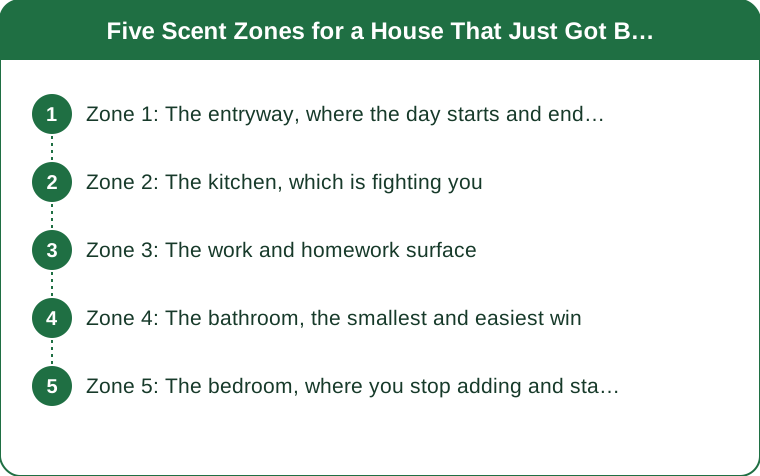
Zone 1: The entryway, where the day starts and ends twice
The entryway is the highest-traffic, lowest-effort zone in the house, and almost nobody scents it deliberately.
It has two completely different jobs in the same day. In the morning it is the last thing anyone smells on the way out. In the afternoon it is the first thing anyone smells coming back in, usually carrying a bag and a bad mood.
What works here: something bright and non-negotiable. Sweet orange, grapefruit, or lemon, on their own or with a small amount of rosemary. Citrus reads as clean and awake without being a statement, and it covers the two things entryways actually smell like — shoes and outdoor air.
Delivery matters more than the oil. A diffuser in an entryway rarely runs long enough to matter, because nobody is standing there. Use a reed diffuser or a scented stone instead — passive, always on, no plug required. Five reeds in a narrow hall is plenty; ten will be overwhelming in a small space.
One practical note: keep it above shoe height and away from where coats brush past. Anything at knee level gets knocked over within a week.
Zone 2: The kitchen, which is fighting you
The kitchen is the hardest zone because it already has a strong scent of its own, and that scent changes four times a day.
The mistake is trying to override it. Diffusing lavender over last night’s garlic produces something worse than either. What you actually want is a scent that sits alongside food smells rather than competing with them.
What works: lemon, lime, and bergamot, plus herbal notes that already belong in a kitchen — rosemary, basil, a little peppermint. These read as clean rather than perfumed, which is the whole goal in a room where people eat.
What does not work: florals, anything sweet or gourmand, and heavy woods. Vanilla in a kitchen smells like a candle shop and makes food taste odd, which is not a metaphor — scent contributes a large share of perceived flavour.
Timing beats intensity here. Run a diffuser for 20 to 30 minutes after cooking, with a window cracked, rather than continuously. Continuous kitchen diffusion just layers scent on scent until the room smells confusing.
A free upgrade: simmer a pan of water with citrus peel and a rosemary sprig for ten minutes. It is genuinely effective, costs nothing, and handles the specific problem of fish or fried food better than any oil.
Zone 3: The work and homework surface
This is the zone where scent does the most measurable work and where most households have none at all.
The target is sustained attention without agitation. That rules out both ends: nothing sedating, nothing so sharp it becomes a distraction after fifteen minutes.
What works: rosemary as the backbone, with peppermint for a short lift and lemon to keep it from turning medicinal. A serviceable ratio is 3 parts rosemary, 1 part peppermint, 2 parts lemon. If peppermint gives anyone a headache — and it does for some people — swap it for spearmint, which is gentler.
Keep the dose low. A desk is a small volume of air and you are sitting inside it for hours. Two to three drops in a small diffuser, run 20 minutes on and 40 off, does more than a continuous strong scent, because scent fatigue sets in fast at close range. After about fifteen minutes at a constant concentration, you largely stop registering it — so continuous diffusion is mostly wasted oil.
A homework-specific tip: use a consistent blend for the same task. The association builds over a few weeks and becomes a genuine start cue, which is more valuable for a distractible ten-year-old than any particular oil.
If anyone at the table has asthma or a respiratory condition, keep diffusion light and the room ventilated, and check with a doctor first. This is general information, not medical advice.
Zone 4: The bathroom, the smallest and easiest win
Bathrooms punch above their weight because the volume of air is tiny and the humidity carries scent well.
They also have the clearest brief: clean, then calm. Morning bathroom and evening bathroom are doing opposite jobs in the same six square metres.
Morning: eucalyptus and peppermint. Both read as clean, both handle steam beautifully, and eucalyptus in a hot shower is genuinely useful in the first weeks of autumn when everyone starts getting congested.
Evening: lavender with a little cedarwood. This is where the evening actually starts, and a bath that smells like the bedroom you are heading to is doing real transition work.
The best delivery here is not a diffuser. A few drops of eucalyptus on the shower floor, away from the direct stream, gets released by the steam and costs nothing. For evening, a couple of drops on a damp washcloth hung on the towel rail works better than a plug-in.
A warning worth repeating: do not add undiluted essential oils directly to bathwater. They do not dissolve, they float as concentrated droplets, and they contact skin at full strength. Mix into a carrier oil or an unscented bath base first, or keep it to steam only.
Zone 5: The bedroom, where you stop adding and start subtracting
The bedroom is the one zone where less is unambiguously better, and it is the one people overdo.
The job here is not to make the room smell of something. It is to give the nervous system a repeated, boring, low-intensity signal that the day is finished. Novelty is the enemy. A blend you find interesting is a blend that keeps you slightly alert.
What works: lavender, cedarwood, and a small amount of roman chamomile or vetiver. Three oils maximum, low dose, same one every night for months.
Run it before, not during. Twenty to thirty minutes of diffusion while you are getting ready for bed, then off. Running a diffuser all night raises humidity, keeps a scent present that you stopped perceiving hours ago, and wastes oil for no benefit.
The linen alternative: a light spritz of a diluted lavender linen spray on the pillow, once, is often better than any diffuser. It is closer to your nose, it fades over the night in a way that matches falling asleep, and there is nothing to switch off.
Children’s rooms: halve everything, keep to lavender or roman chamomile, and place the diffuser well away from the bed. Some oils — peppermint and eucalyptus in particular — are not recommended near young children’s faces at all.
FAQ: House Scent Questions, Answered
How many diffusers do I actually need?
One or two, moved deliberately, plus passive options in the other zones. Reeds in the entryway, steam in the bathroom, a linen spray in the bedroom, and one plug-in diffuser that lives wherever the day is happening. Five running diffusers is expensive and produces a muddle where the zones meet.
Why does my house smell like nothing to me but strong to guests?
Olfactory adaptation. You stop registering a constant background scent within minutes, and guests arrive fresh. If you can smell your own house scent clearly, it is almost certainly too strong. Ask someone who does not live there.
Do the zones need to smell related to each other?
Not in a hallway-length house, where the transitions are quick. In an open-plan space, yes — pick blends that share one common oil, usually a citrus, so the boundaries do not clash. Overlapping unrelated blends is the single most common reason a scented home smells confused rather than considered.
TL;DR:
- Five zones, five jobs. Entryway, kitchen, work surface, bathroom, bedroom. One diffuser in the middle of the house serves none of them.
- Entryway: citrus, passive delivery, above shoe height.
- Kitchen: citrus and culinary herbs, run 20 to 30 minutes after cooking, never continuously.
- Work surface: rosemary and mint, low dose, 20 on and 40 off — scent fatigue makes continuous diffusion pointless.
- Bathroom: eucalyptus by steam in the morning, lavender in the evening. Never neat oil in bathwater.
- Bedroom: three oils maximum, the same ones every night, running before bed and off overnight.
The house got busy again. The scent plan should match where people actually are, not where the diffuser happened to be in July.
Keep Reading
This article is for general informational purposes only and is not medical advice. Always consult a qualified health professional for guidance specific to you.