Peppermint Before a Workout: Which Scents Actually Change How You Train
Quick Answer: Scent will not add muscle or fitness, but small studies keep finding that peppermint inhaled before or during exercise lowers perceived effort and sharpens alertness - enough that the same workout feels noticeably easier. Citrus and rosemary lean energizing, lavender belongs after training, not before. The practical format is a personal inhaler stick or a drop on a wristband, never neat oil on skin and never a diffuser in a shared gym.
Athletes have sniffed things before competing for as long as sport has existed - smelling salts, cut lemons, menthol rubs. The modern version fits in a pocket, costs almost nothing, and has just enough science behind it to be worth doing properly.
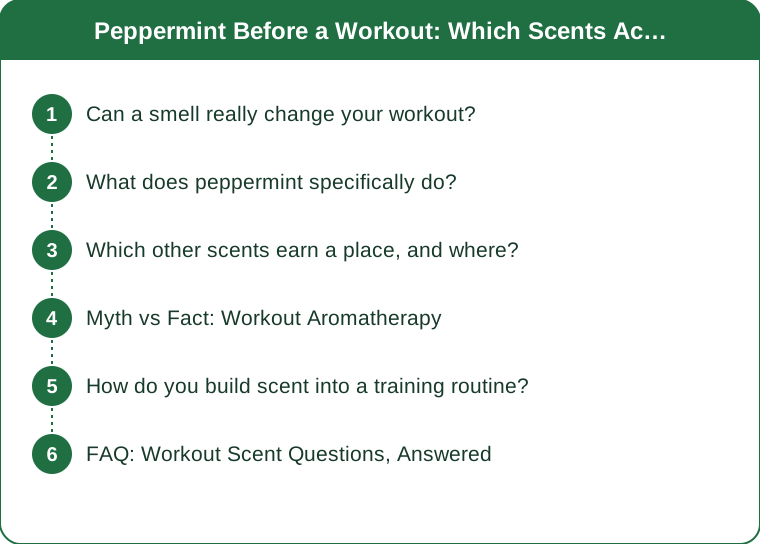
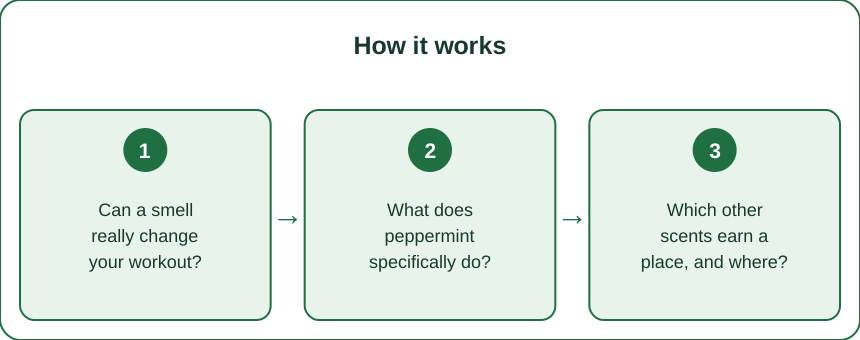
Can a smell really change your workout?
Modestly, measurably, and mostly through your brain rather than your muscles - which is less mystical and more useful than the marketing suggests.
Smell is the sense with the shortest route to the brain’s emotion and arousal circuitry: odor signals reach the limbic system with fewer relays than sight or sound. That anatomy is why a scent can shift alertness, mood, and perceived effort within seconds - and why the effects are real but bounded. No oil changes your VO2 max.
What small human studies have actually found:
- Lower perceived effort. Peppermint inhalation during exercise has repeatedly nudged down ratings of how hard the work feels - the same pace registering as slightly easier.
- Sharper alertness and reaction time. Peppermint and rosemary both show small improvements in attention-task performance in lab settings.
- Occasionally, small performance bumps - a bit more grip endurance or a few extra seconds to exhaustion in some trials, not all. The honest summary is sometimes, slightly.
The caveats that keep this honest: studies are small, effects vary between people, and expectation is doing part of the work - a scent you believe in helps more. But unlike most supplements sold on that same placebo margin, scent is nearly free, has no dose to get wrong internally, and pairs with a second mechanism - habit cueing - that is arguably stronger than the pharmacology. That second mechanism gets its own section, because it is the one you can engineer.
What does peppermint specifically do?
Peppermint is the best-studied workout scent by a wide margin, and its effects cluster in three places:
Perceived effort drops. The headline finding, replicated in several small trials: the same treadmill pace or the same set feels a notch easier with peppermint in your nose. Menthol - peppermint’s active molecule - stimulates cold-sensitive receptors, and that cooling signal appears to take the edge off effort and heat discomfort. This is also why menthol shows up in serious sports-science work on exercising in hot conditions: the sensation of cooling improves how heat feels even when body temperature is unchanged - genuinely useful for August training, with the equally real warning that feeling cooler is not being cooler. Hydration and pacing rules do not care what your nose reports.
The airways feel more open. Menthol creates a sensation of easier breathing - measured airflow barely changes, but the felt difference is why peppermint suits cardio sessions and stuffy home gyms.
Alertness ticks up. Useful for the 6am session or the post-work slump workout, where the real opponent is grogginess rather than gravity.
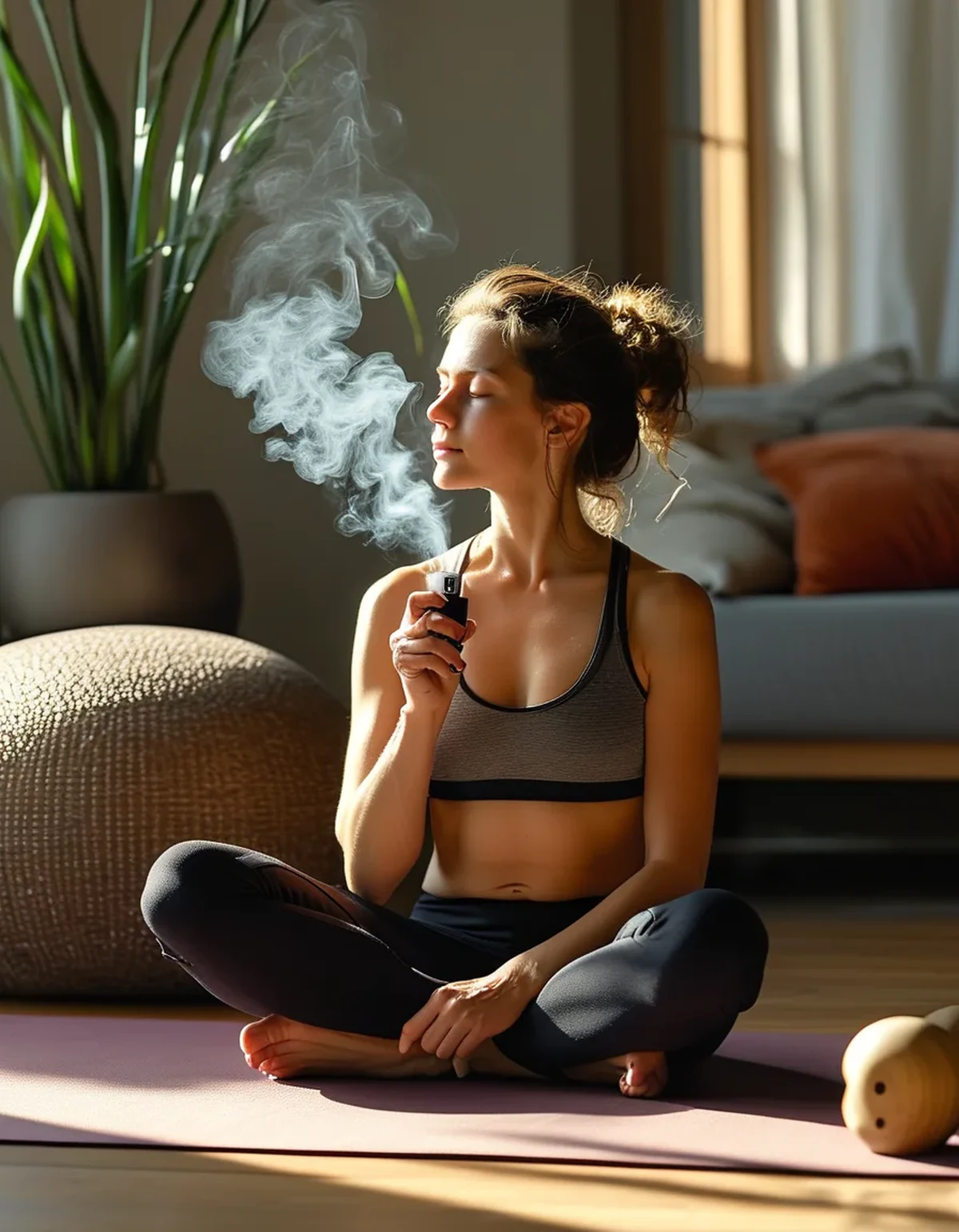
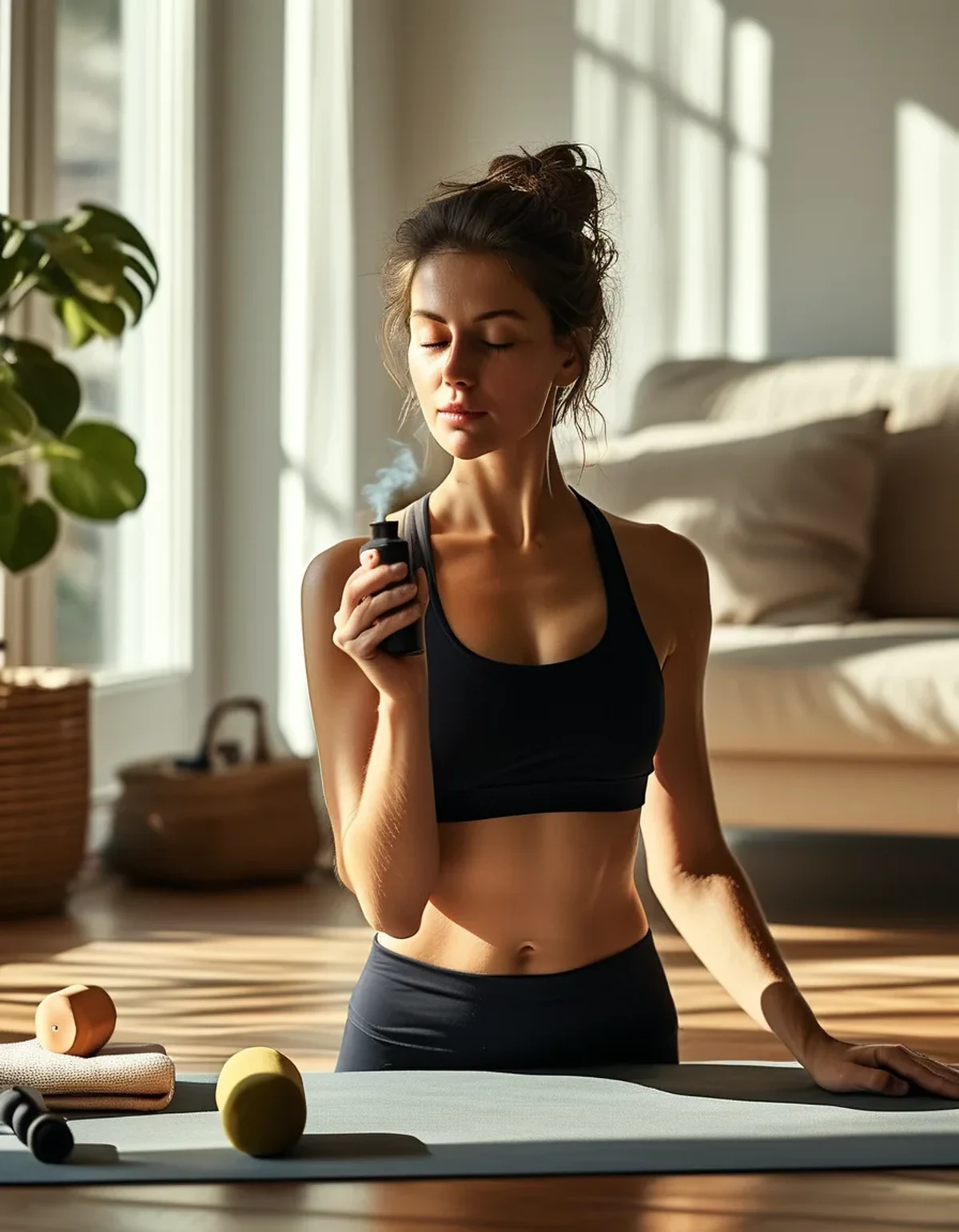
How to use it: two or three slow inhalations from an inhaler stick before the session, repeated between hard intervals if you like. Peppermint is a sprint scent, not a marinade - constant exposure fades through adaptation within minutes anyway, which is one more argument against fumigating the whole room.
Skip menthol products near the eyes, on broken skin, and anywhere on young children - and anyone with asthma should test cautiously, since menthol sensations and airway irritation are individual. This is general information, not medical advice.
Which other scents earn a place, and where?
A short, honest roster - matched to the right moment rather than stacked all at once:
Citrus - lemon, orange, grapefruit - for mood and pre-workout inertia. The research base is thinner than peppermint’s but points consistently toward mild mood lift and alertness. Citrus is the scent for the days the obstacle is starting at all: pair it with putting on your workout clothes and let it mark the transition into training mode.
Rosemary - for focus-heavy sessions. Small studies associate rosemary inhalation with improved attention and working-memory task performance. If your training involves skill work - lifting technique, dance choreography, a sport drill - rosemary before practice is the fit.
Lavender - strictly for afterward. The best-evidenced relaxation scent, with reasonable support for calming pre-sleep arousal. Before training it is counterproductive by design; after an evening session, a lavender shower product or pillow mist helps the wind-down that hard late workouts disrupt. The before-and-after pairing - peppermint in, lavender out - is the whole system in two bottles.
Eucalyptus - the shower scent. Functionally a cousin of menthol, best deployed as a post-workout steam-shower drop (on the floor away from the stream, not on skin) where it makes the cool-down feel like a spa decision.
What did not make the roster: anything sold as a blend promising energy, detox, or fat burn. Blends are fine as preferences, but the evidence, such as it is, attaches to single well-studied oils - and preference alone works better when it costs less.
Myth vs Fact: Workout Aromatherapy
Myth: Essential oils boost metabolism and burn fat. Fact: No credible evidence supports any inhaled scent changing energy expenditure meaningfully. The documented effects live in perception - effort, alertness, mood - which can help you train more and better, which is the only fat-relevant pathway involved.
Myth: If a little scent helps, a diffuser running all session helps more. Fact: Olfactory adaptation erases a constant scent within minutes - your nose files it as background and stops reporting it. Intermittent inhalation preserves the effect; a running diffuser mostly perfumes your equipment. In shared spaces it also imposes your choices on every set of lungs present, including asthmatic ones.
Myth: Applying peppermint oil to sore muscles treats the soreness. Fact: Menthol rubs create cooling sensations that pleasantly distract from soreness - a legitimate comfort - but they do not accelerate recovery, and undiluted essential oil on skin is a chemical burn risk. If you want the ritual, use a properly formulated diluted product, never neat oil.
Myth: Natural means safe for everyone. Fact: Concentrated plant chemistry is still chemistry: oils can trigger asthma and migraines, irritate skin, and several are toxic to cats and dogs at ambient levels a home diffuser produces. Pregnant women should run oil habits past a professional. The inhaler-stick format solves most of this by keeping the dose personal.
Myth: The science is settled either way. Fact: The trials are small, short, and heterogeneous - enthusiasts overstate them, skeptics dismiss real replicated signals. The grown-up position: cheap, low-risk, modest effect, worth using precisely as the minor tool it is.
How do you build scent into a training routine?
The pharmacology is the smaller half. The bigger half is conditioning: a consistent scent becomes a start signal that your brain associates with training, the same mechanism as a pre-lift playlist or a coffee-then-run sequence - except scent’s shortcut to the limbic system makes it an unusually strong cue.
The setup, in four rules:
1. One scent, one meaning. Pick a single training scent - peppermint is the default - and stop using it anywhere else. A scent that also perfumes your car and your desk cues nothing. Exclusivity is what builds the trigger.
2. Use the personal formats. A nasal inhaler stick (a few drops on the cotton wick, lasts weeks, costs little) is the ideal: pocket-sized, zero broadcast, renewable. Second best: a drop on a wristband, a cotton ball in a small tin, or a dab on the towel - never directly on skin, never in eyes-adjacent territory mid-sweat.
3. Anchor it to the same moment. Two slow inhalations at the same point every session - shoes tied, before the first working set. Consistency of placement is what converts a nice smell into a Pavlovian starting gun. Within a few weeks, the scent alone starts generating readiness on the days motivation forgot to show up.
4. Keep lavender on the far side. If you also run an evening wind-down scent, keep the pair strictly separated by function. A brain that has learned peppermint-means-work and lavender-means-rest has gained two levers cheaper than any supplement.
Expectations set honestly: on a good day scent shaves the felt effort and sharpens the start; on a bad day it at least starts the engine. That is the whole promise - and at this price, it clears it.
FAQ: Workout Scent Questions, Answered
Is it rude to use scents at a shared gym?
Broadcast formats are - diffusers, sprays, and heavy application impose on shared air, and gyms are full of hard-breathing people with asthma and migraine triggers. Personal formats are the polite answer: an inhaler stick delivers a full dose to you and nothing detectable a bench away.
Can I just use peppermint gum or mints instead?
Largely yes - menthol is menthol, and gum adds the small alertness bump chewing itself provides. The inhaler wins for intensity of the cooling-airway sensation and for not chewing during heavy lifts, but gum is the low-friction version and the research on menthol in the mouth during heat is respectable.
Do scent effects wear off as I get used to them?
Within a session, yes - adaptation mutes a constant scent in minutes, which is why intermittent sniffs beat continuous exposure. Across weeks, the pharmacological edge may soften, but the conditioning effect strengthens - the cue value grows with every consistent pairing, so the tool gets better even as the novelty fades.
Which single product should a beginner buy?
One blank nasal inhaler stick plus a small bottle of peppermint essential oil - a setup that costs less than a gym smoothie and lasts a season. Add lavender for evenings only if sleep wind-down is a real problem you are working on. Everything past that is fragrance shopping, which is fine, as long as it stops claiming to be sports science.
TL;DR:
- Small studies repeatedly find peppermint lowers perceived effort and sharpens alertness; citrus lifts mood, rosemary aids focus, lavender is for after
- Menthol makes heat feel cooler without cooling you - pleasant in August, but hydration rules still apply
- Use personal formats: an inhaler stick or a drop on a wristband - never neat oil on skin, never a diffuser in shared air
- Intermittent sniffs beat constant exposure; your nose adapts to background scent in minutes
- The strongest effect is the conditioned cue: one exclusive scent, same moment every session, becomes a start signal
Scent is the cheapest legal edge in fitness precisely because the edge is small and honest: the workout feels a little easier, starts a little more automatically, and costs pocket change. Take the modest win and spend the supplement budget on groceries.
Keep Reading
This article is for general informational purposes only and is not medical advice. Always consult a qualified health professional for guidance specific to you.