5 Ways to Make a Room Actually Hold Its Scent
Quick Answer: Scent fades for three reasons: air movement carries it away, hard surfaces give it nothing to cling to, and your own nose stops registering a constant smell within minutes. The fixes are placement out of draughts and low in the room, soft furnishings to hold the molecules, intermittent rather than continuous diffusing, layering two delivery methods, and switching scents before your nose adapts.
Most people respond to a fading scent by adding more oil. That is the one thing that reliably does not work.
Tip 1: Stop fighting the airflow
Placement beats quantity, and most diffusers are in exactly the wrong spot.
Scent molecules move with air. Put a diffuser near an open window, a doorway, or an air conditioning vent and you are running an extraction system - the scent leaves the room as fast as it is produced. A diffuser on a high shelf in a warm room does something similar, since warm air rises and takes the scent to the ceiling.
Where to put it:
- Low to mid height, roughly at seated nose level rather than above head height. Scent disperses upward naturally, so starting high means most of it never reaches you.
- Away from doorways and windows, ideally in the part of the room with the least air movement.
- Not directly next to a radiator or in direct sun - heat accelerates evaporation, so you get a strong ten minutes and then nothing.
- Near where you actually sit, not in the middle of the room. Scent is strongest within a couple of metres.
One counterintuitive point: a completely sealed room is not the goal either. Some gentle air circulation distributes scent evenly instead of leaving a strong pocket and a dead zone. A ceiling fan on its lowest setting often improves perceived scent across a room.
Tip 2: Give the scent something to hold onto
Hard surfaces are terrible at holding scent. Soft ones are excellent, and this is the difference between a room that smells nice for twenty minutes and one that smells nice all evening.
Scent molecules land on surfaces and re-release slowly over time. Fabric, with its enormous surface area, holds far more than glass, tile, or painted plaster. This is why a room with rugs, curtains, cushions, and a sofa holds scent for hours while a minimally furnished room with a wooden floor loses it immediately.
How to use this deliberately:
- Put a few drops on a cotton pad and tuck it behind a cushion or under a sofa. Out of sight, no marks, and it releases for days.
- Scent the curtains lightly with a diluted spray. Curtains sit in the airflow path and act as a slow-release surface every time air moves past.
- Use a wool or felt diffuser stone, which holds oil far longer than a reed set in a small room.
- A drop on the inside of a lampshade - as the bulb warms, the scent lifts gently.
Do not put neat oil directly on fabric you care about. Many oils stain and some degrade fibres. Dilute, test somewhere hidden, and use a cotton pad as the carrier where possible.
Tip 3: Diffuse intermittently, not continuously
The reason you cannot smell your own diffuser after ten minutes is not the diffuser. It is your nose.
Olfactory adaptation is the process by which your smell receptors stop responding to a constant, unchanging odour. It happens within minutes, and it is why you cannot smell your own home when you walk in but a visitor can. Running a diffuser continuously guarantees adaptation, so you fill the room with scent you have stopped perceiving.
The fix is intermittent operation:
- Most ultrasonic diffusers have an interval mode - 30 seconds on, 30 seconds off, or similar. Use it. It uses less oil and you perceive more.
- If yours has no interval setting, run it for 20 to 30 minutes and then switch it off for an hour. You will notice it again when it restarts.
- Leave the room briefly. Two minutes in the hallway resets your perception considerably.
This also saves money. Continuous running burns through oil while producing diminishing perceived benefit. Many people who feel their oils do not last are running them at maximum, continuously, in a draughty room - and then buying more oil.
Tip 4: Layer two delivery methods
A single method gives you one release curve. Two give you a longer, more even one.
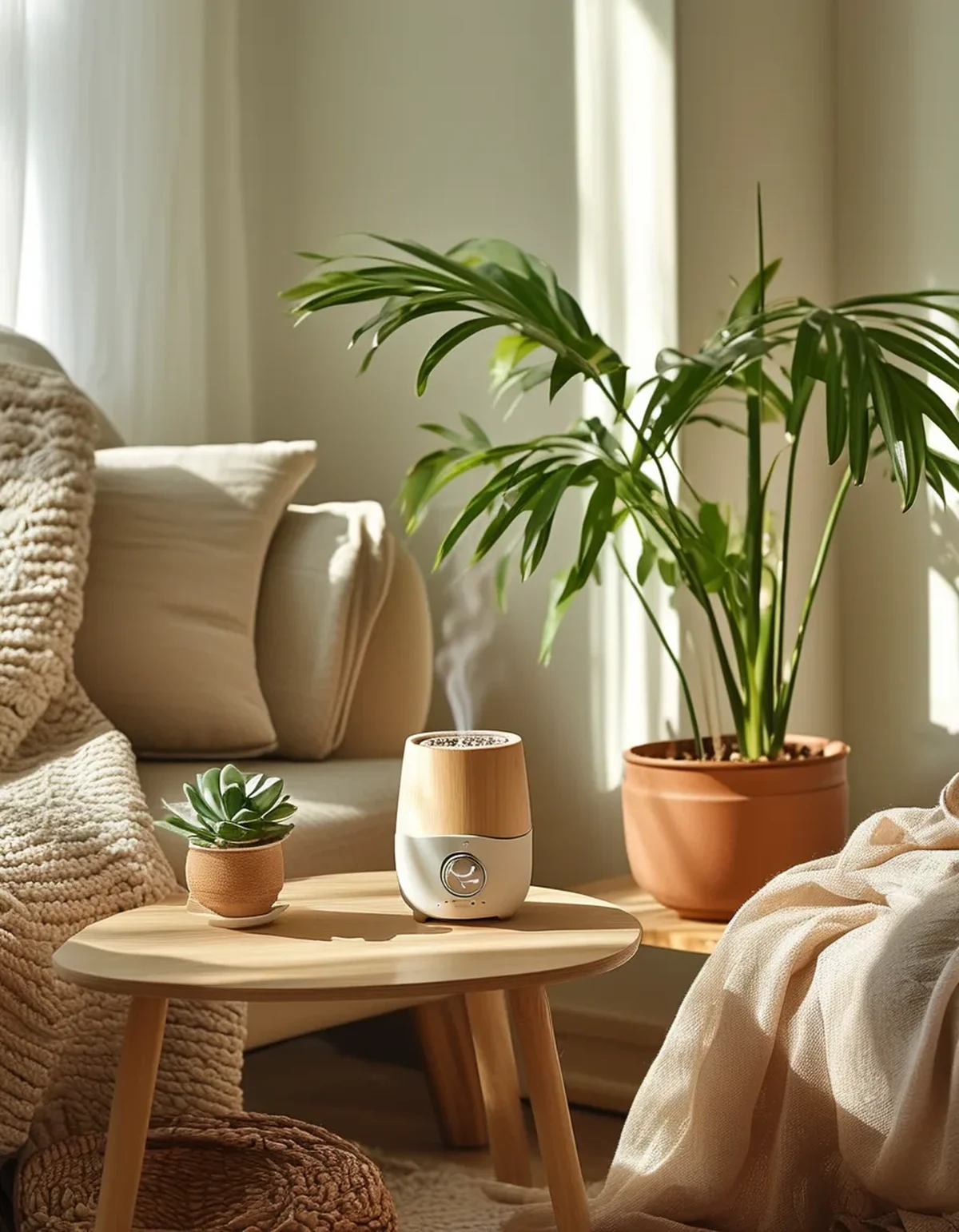
Different methods release at different speeds. A candle or a diffuser produces scent quickly and stops when it stops. A reed diffuser or a scented cotton pad releases slowly and continuously for days. Used together, the slow method maintains a baseline and the fast one adds a peak when you want it.
A practical layering:
- Baseline: a reed diffuser or a few oiled cotton pads tucked around the room, refreshed weekly
- Peak: an ultrasonic diffuser on interval mode, or a candle, run for the hour before and during the time you actually use the room
Match the scents rather than stacking unrelated ones. Two different complex blends running at once usually read as confused rather than layered. Pick a common note - both citrus-forward, both woody - or use the same oil in both.
A simpler version of layering: put a few drops on the cardboard tube inside your toilet roll, on the filter of a fan, or on a radiator-safe wooden clip. Anything that sits in the path of moving air becomes a passive diffuser, and passive diffusers are what carry a room between active sessions.
Tip 5: Rotate the scent before your nose stops noticing
Adaptation is not only a minute-by-minute effect. It builds over weeks with the same scent, and it is the reason a blend you loved in June does nothing for you by September.
Rotate on a schedule rather than waiting to get bored. Roughly every two to three weeks is enough for most people, and switching between scent families does more than switching within one.
A rotation that works with the season: late summer suits bright, green, and citrus notes - bergamot, lemongrass, basil, mint. As the weather turns, moving toward warmer notes - cedarwood, vetiver, sweet orange, clove - marks the change and gives your nose something genuinely new.
Keep a small rotation, not a large collection. Three or four oils you actually finish beat twenty half-used bottles that oxidise. Citrus oils in particular degrade within about a year of opening and start smelling flat or slightly sharp.
Store them properly: dark glass, lid tight, cool cupboard, away from sun. Heat and light are what turn a good oil into a dull one, and a dull oil is often mistaken for a nose problem or a diffuser problem.
If anyone in the home has asthma or respiratory sensitivity, or there are pets - cats in particular are sensitive to several common oils - check what is safe before diffusing. This is general information, not medical advice.
FAQ: Room Scent Questions, Answered
Why can visitors smell my home but I cannot?
Olfactory adaptation. Your receptors have stopped responding to the constant background odour of your own home. Leaving for a few hours and returning is the only reliable way to smell it yourself.
How many drops should I use in a diffuser?
Usually 3 to 6 drops per 100ml of water for a small room. More does not produce more perceived scent once adaptation kicks in, and it does use up oil considerably faster.
Do reed diffusers actually work?
Yes, as a slow baseline rather than a strong presence. Flip the reeds every few days to refresh the release. They struggle in draughty rooms and in very large spaces.
Is a candle or a diffuser better?
A candle produces stronger, faster scent throw and adds warmth and light; a diffuser gives more control, no flame, and works with a wider range of oils. Layering one of each is more effective than choosing between them.
Why does my house smell different in humid weather?
Humidity affects how scent molecules disperse and how surfaces hold them, and warm humid air generally carries scent more readily. A blend that felt right in cool weather can read as heavy in a humid late-summer room.
TL;DR:
- Placement beats quantity: low, away from draughts, near where you sit
- Soft furnishings hold scent for hours; hard surfaces hold none - use cotton pads and curtains
- Run diffusers intermittently, since your nose stops registering a constant smell within minutes
- Layer a slow baseline with a fast peak, matching the scent families
- Rotate every two to three weeks and store oils dark, cool, and tightly closed
If your oils seem to stop working after ten minutes, the oils are almost certainly fine. Fix the airflow, give the scent something soft to land on, and stop running the diffuser continuously - and the same bottle will last longer and be noticed more.
Keep Reading
This article is for general informational purposes only and is not medical advice. Always consult a qualified health professional for guidance specific to you.