5 Ways to Keep a Gym Bag Fresh Without Overpowering the Room
Quick Answer: Smell in a gym bag is a moisture problem before it is a scent problem, so the fixes that work are drying and airflow first, then a low-dose scent. A cotton sachet with 3 to 5 drops of tea tree or lavender, a bicarbonate of soda pouch, and unzipping the bag the moment you get home handles almost all of it. Never apply oils directly to bag fabric or to synthetic kit.
There is a specific moment - opening a gym bag that has been zipped shut since yesterday - that no amount of expensive kit prevents. And the usual response, spraying something floral into it, makes the problem more complicated rather than less.

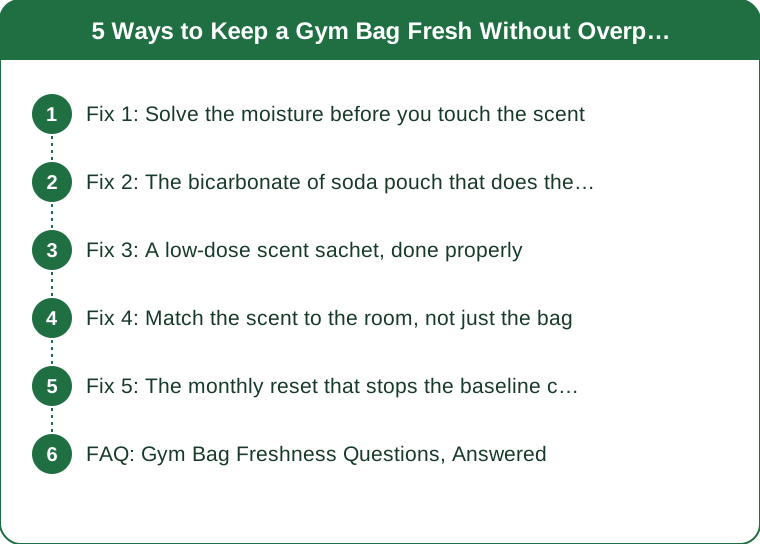
Fix 1: Solve the moisture before you touch the scent
Bag smell is bacterial, and bacteria need moisture. Everything else on this list is secondary to this one.
Unzip the bag the moment you get home. Not in an hour. A zipped bag holding damp kit at room temperature is a warm humid chamber, and the smell that develops in the first few hours is the smell you will be fighting for a week.
Take the kit out and hang it, even if you cannot wash it yet. Damp fabric bundled in a bag transfers moisture and bacteria to the bag lining. Hung over a rail, most kit is dry in a few hours and the bag stays clean.
Wet items get their own waterproof pouch. Swimwear, a wet towel, or a rained-on jacket should never sit against the bag lining. A cheap dry bag or even a zip bag prevents most lasting bag odour.
Dry the bag itself, not just the contents. After a wet session, turn the bag inside out where possible and leave it open somewhere with airflow. Ten minutes of attention prevents the accumulated musty note that never quite washes out.
Shoes come out every time. Trainers left in a closed bag are the single largest odour source, and they keep the bag lining damp. Out, insoles pulled, somewhere ventilated.
Fix 2: The bicarbonate of soda pouch that does the unglamorous work
Before scent, absorb. Bicarbonate of soda is genuinely effective on odour compounds rather than just masking them, and it costs almost nothing.
How to make it: fill a small cotton drawstring pouch or a clean sock with about 3 tablespoons of bicarbonate of soda, tie it closed, and leave it in the bag permanently. Replace it monthly.
Why it works: many of the compounds responsible for sweat and mildew smells are acidic, and bicarbonate neutralises rather than covers them. This is why it works on the smell itself while a fragrance spray simply adds a second smell on top.
Where to put it: in the main compartment, not the shoe pocket, since the main compartment holds the fabric that carries most of the odour.
Add activated charcoal for the shoe compartment. A small charcoal pouch handles trainer smell more effectively than bicarbonate and lasts a few months. Refresh it in sunlight for a few hours occasionally.
One caution: loose bicarbonate in a bag makes a white mess of everything and does not work better than a contained pouch. Keep it in fabric.
The order matters - absorb first, then scent lightly. Scenting a bag that still smells means you now have two smells, and the combination is usually worse than either.
Fix 3: A low-dose scent sachet, done properly
Once the bag is dry and the absorbing is handled, a small amount of scent is genuinely pleasant. The mistake is dose.
How to make it: a small cotton or muslin drawstring bag with a few cotton wool balls inside, and 3 to 5 drops of essential oil on the cotton wool. That is the whole recipe, and 3 to 5 drops is not an under-estimate - an enclosed bag concentrates scent enormously.
Which oils suit a gym bag:
- Tea tree - the traditional choice, with a clean medicinal note and useful antimicrobial properties
- Lavender - soft, familiar, and inoffensive to almost everyone
- Eucalyptus - fresh and bright, though strong; use 2 to 3 drops rather than 5
- Lemon or grapefruit - clean and light, but they fade fastest
- Peppermint - very strong; 1 to 2 drops maximum or the whole bag becomes a mint tin
Refresh every 1 to 2 weeks, when you can no longer smell it with the bag open.
Critical rules:
- Never put oils directly on the bag fabric or lining - undiluted oils stain, degrade synthetic coatings, and the smell becomes permanent rather than adjustable
- Never on your kit - oils can stain technical fabrics and undiluted oil against skin during a workout risks irritation
- Keep the sachet away from anything you eat from, and away from a laptop or headphones sharing the bag

Fix 4: Match the scent to the room, not just the bag
This is where enthusiasm turns into a shared-space problem, and it is worth thinking about for one minute.
Changing rooms are small, warm, and enclosed. A scent that reads as pleasant in your kitchen can be overwhelming when a bag is opened in a shared space, and some people get headaches or respiratory irritation from strong fragrance.
Keep it low and clean rather than sweet and heavy. Citrus, lavender, and tea tree at low doses read as clean. Heavy florals, ylang ylang, and anything vanilla-adjacent read as perfume, which is far more noticeable to other people.
One scent, not three. Layering a scented laundry detergent, a fabric spray, a deodorant, and a bag sachet produces a muddle rather than a signature. Pick the bag sachet and let the detergent be unscented.
Skip fragrance entirely for yoga and pilates studios. These are close-quarters, floor-level, breathing-focused environments and many studios explicitly ask for no fragrance. A bicarbonate pouch and a dry bag cover you with no scent at all.
Consider people around you generally. Fragrance sensitivity and asthma are common, and a strongly scented bag opened next to someone on the next bench is not a neutral act. Low dose is not just tasteful, it is considerate.
And avoid oils around pets at home - several common essential oils including tea tree, eucalyptus, and citrus are not safe for cats and dogs at concentration. Keep the sachet in the bag and the bag off the floor.
Fix 5: The monthly reset that stops the baseline creeping
Bags accumulate. Every few weeks the baseline smell rises slightly, and after six months no amount of sachet fixes it.
Once a month, empty it completely. Everything out, including the things that live in the bottom - old hair ties, a shrivelled banana, a spare sock, receipts. The debris layer is a genuine odour source.
Vacuum the inside. Thirty seconds with a nozzle attachment removes dust, sand, and hair that hold smell.
Wipe the lining. A cloth with warm water and a little washing-up liquid, or a 50:50 water and white vinegar solution for anything persistent. Vinegar smells briefly and then disappears, taking the odour with it. Let it dry completely open before repacking.
Check whether the bag is machine washable. Many gym bags are, on a cold gentle cycle. Air dry, never tumble - heat damages coatings and zips.
Then rebuild the system: fresh bicarbonate pouch, fresh charcoal pouch in the shoe section, fresh scent sachet with 3 to 5 drops.
Replace the shoe insoles occasionally too. Insoles hold odour more than the shoes themselves, and new ones are inexpensive. If a bag keeps smelling despite everything, the insoles are usually the culprit.
FAQ: Gym Bag Freshness Questions, Answered
Can I put essential oils directly on my gym clothes?
Best not to. Undiluted oils can stain technical fabrics, may degrade elastane, and oil against skin during a sweaty session can cause irritation or increase photosensitivity with citrus oils. Scent the bag, not the kit.
How many drops is too many?
In an enclosed bag, more than about 5 drops on cotton wool becomes noticeable to everyone in a changing room. Start with 3 and add only if you genuinely cannot smell it with the bag open.
Do commercial gym bag sprays work?
Most mask rather than neutralise, so they help briefly and add a second smell to a bag that still has the first. If the bag is dry and clean, a light spray is fine as a finishing touch; on a damp bag it achieves nothing.
What about the smell that will not go away no matter what?
That is usually mildew in the lining seams from repeated damp storage, or the insoles of shoes that live in the bag. Wash the bag if you can, replace the insoles, and use a waterproof pouch for wet items from now on.
TL;DR:
- Bag smell is a moisture problem first - unzip and empty it the moment you get home
- Keep a bicarbonate of soda pouch in the main compartment and charcoal in the shoe section
- Scent with 3 to 5 drops of oil on cotton wool inside a cotton sachet, never on bag fabric or kit
- Keep the dose low and the scent clean out of consideration for shared changing rooms
- Do a monthly full empty, vacuum, and wipe, and replace shoe insoles occasionally
The appealing part of this is the sachet, and the part that actually works is unzipping the bag and hanging the kit. Do the boring half properly and the scent becomes a nice detail rather than a cover story.
Keep Reading
This article is for general informational purposes only and is not medical advice. Always consult a qualified health professional for guidance specific to you.