5 Essential Oil Blends Matched to 5 Specific Times of Your Day
Quick Answer: Citrus blends work best for morning energy, peppermint or rosemary for midday focus, lavender-based blends for afternoon stress resets, cedarwood or sandalwood for evening wind-down, and a low-dose lavender-chamomile blend for bedtime. Matching the blend to the hour works better than one all-purpose scent all day.
Most people own one diffuser blend and use it around the clock — which misses how differently your body and mind need to feel at 7am versus 9pm. Here are 5 pairings built around the actual rhythm of a day.

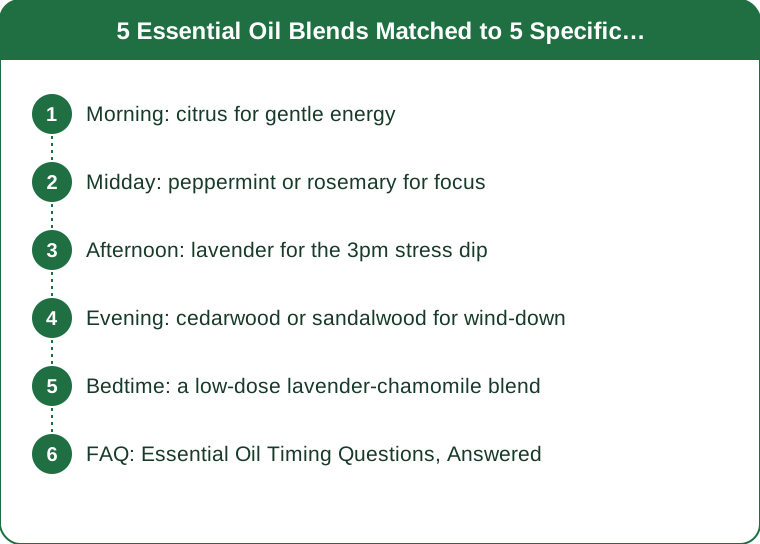
Morning: citrus for gentle energy
Lemon or sweet orange, diffused for 15-20 minutes during your morning routine, is commonly used for a light energizing effect without the jitteriness of caffeine. Unlike peppermint, citrus tends to feel uplifting rather than sharply stimulating, which suits an easing-into-the-day mood better than a jolt.
Midday: peppermint or rosemary for focus
Peppermint diffused at your desk for a focused work block, or rosemary as an alternative, are commonly associated with alertness and concentration. Keep sessions to 20-30 minutes rather than running all day — continuous exposure to any strong scent tends to reduce its perceived effect over time (olfactory fatigue).
Afternoon: lavender for the 3pm stress dip
The afternoon energy and mood dip many people experience responds well to lavender, diffused for 10-15 minutes as a reset rather than a sedative at this hour — lavender’s calming association works for stress reduction without necessarily making you drowsy at low diffusion doses.

Evening: cedarwood or sandalwood for wind-down
As the day transitions toward rest, woodsy notes like cedarwood or sandalwood are commonly used to signal a mental shift away from work-mode alertness, without the fully sedative association some people have with lavender specifically at bedtime.
Bedtime: a low-dose lavender-chamomile blend
A gentle lavender and chamomile blend, diffused at low intensity for the first 20-30 minutes after you get into bed (not run all night), is a commonly used combination for supporting a calm transition into sleep. Running a diffuser continuously all night isn’t necessary for the effect and can affect air quality in a closed bedroom.
FAQ: Essential Oil Timing Questions, Answered
Can I use the same blend all day instead of switching?
You can, but olfactory fatigue means you’ll likely stop noticing the effect after prolonged exposure — switching blends through the day tends to keep each one more noticeably effective.
Is it safe to diffuse oils around pets?
Some oils, including tea tree and certain citrus oils, can be harmful to cats and some other pets even via diffusion. Check pet-specific safety guidance for your specific animal before diffusing regularly.
Do essential oils actually have scientifically proven effects, or is it just the ritual?
Evidence varies significantly by oil and outcome — some effects (like lavender for mild relaxation) have more research support than others. The ritual and expectation likely contribute to the experience alongside any direct chemical effect.
TL;DR:
- Citrus mornings, peppermint or rosemary midday, lavender for the afternoon dip
- Cedarwood or sandalwood signal evening wind-down without full sedation
- Low-dose lavender-chamomile at bedtime, not run all night
- Switching blends through the day avoids olfactory fatigue dulling the effect
Check pet-specific oil safety before diffusing regularly if you share your home with animals.
Keep Reading
This article is for general informational purposes only and is not medical advice. Always consult a qualified health professional for guidance specific to you.