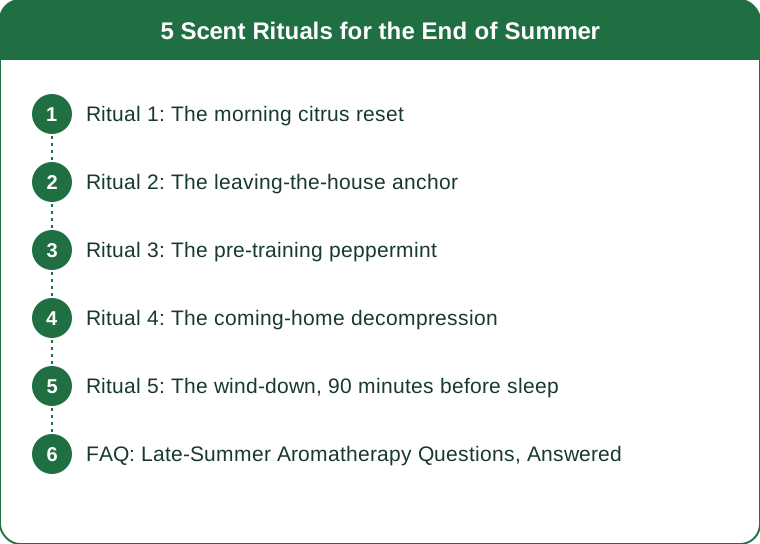
5 Scent Rituals for the End of Summer
Quick Answer: The most useful late-summer scent rituals are the ones attached to a transition point in the day - waking, leaving the house, returning home, training, and winding down. Citrus and peppermint suit the first half of the day, while vetiver, cedarwood, and lavender suit the second. Attach each scent to a specific moment and the association does most of the work.
The end of summer sits oddly. It is still hot, but the light has changed and the year is clearly turning. Scent is unusually good at marking that kind of transition, provided you tie it to something you already do.
Ritual 1: The morning citrus reset
Attached to the moment you get out of bed, before anything else happens.
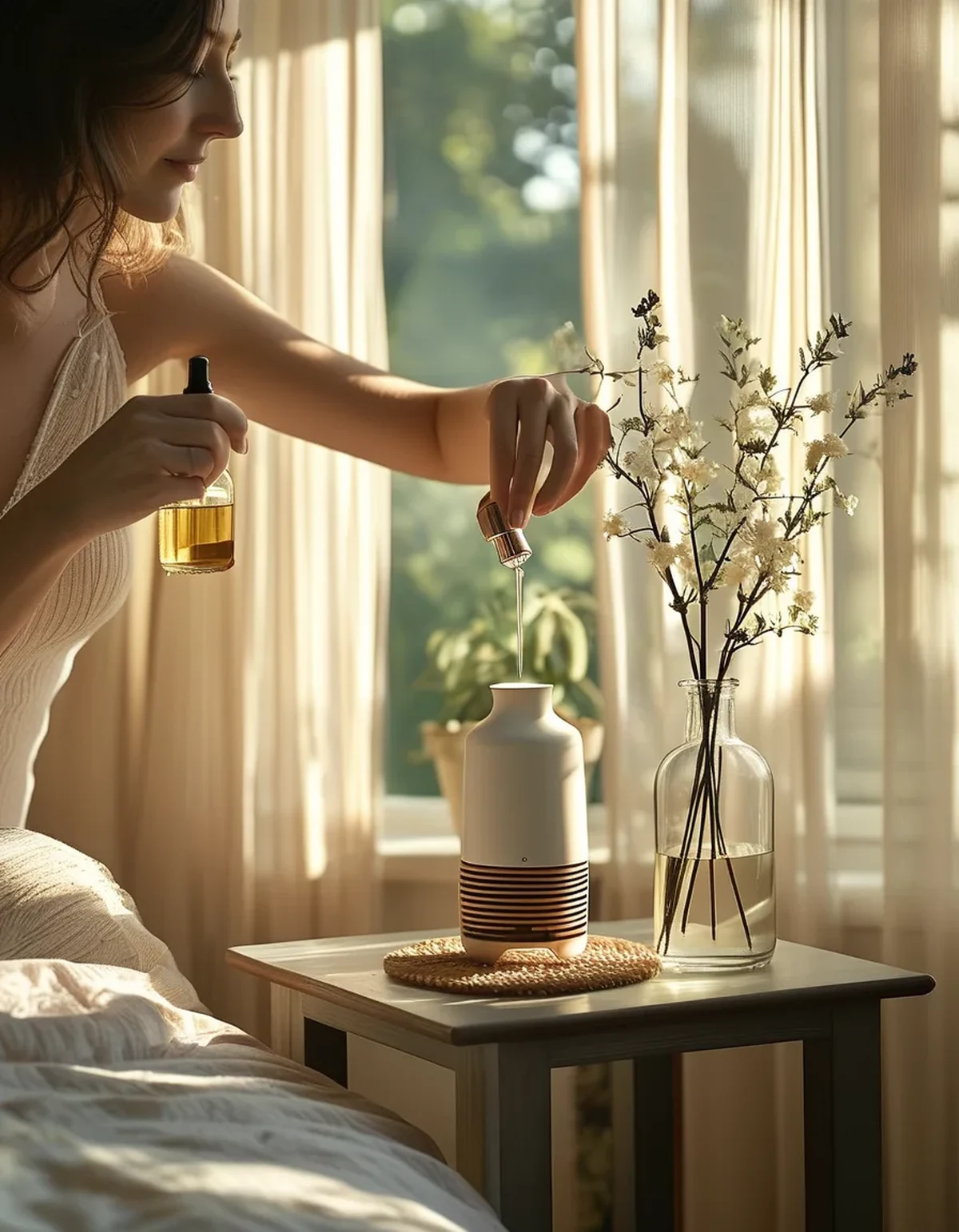
What to use: grapefruit, bergamot, or sweet orange, 3 to 4 drops in a diffuser, or a single drop on a tissue tucked near where you get dressed. Citrus oils are volatile and disperse quickly, which suits a short morning window - you get the effect for fifteen minutes and then it is gone rather than lingering all day.
Why citrus in the morning: the association with brightness and alertness is strong and near-universal, and the top notes hit fast rather than building slowly. That matters when the window is short.
The practical version: put the diffuser on the bathroom shelf and start it while the shower runs. The steam carries it, the timing is automatic, and you never have to remember a separate step.
A caution worth knowing: bergamot and several citrus oils are phototoxic on skin - they increase sensitivity to sunlight and can cause burns or lasting pigmentation. Diffusing is fine. Applying to skin before sun exposure is not, and late August still has meaningful UV. If you use citrus on skin, use it on covered areas or in the evening.
Ritual 2: The leaving-the-house anchor
A single scent applied at the door, every time, becomes a genuine transition marker within a couple of weeks.
What to use: a rollerball at the wrists or the back of the neck, made with a carrier oil at roughly 2 percent dilution - about 12 drops of essential oil per 30ml of carrier such as jojoba or fractionated coconut.
A blend that works for late summer: 6 drops bergamot, 4 drops rosemary, 2 drops peppermint. Bright but not sweet, and the rosemary and peppermint keep it from feeling like a summer holiday scent when the mornings start cooling.
Why the door specifically: you are building an association between a scent and a state. The strength of the association comes from consistency of context, not from the oil itself. Applied at the same point in the same place every day, the scent starts to cue the state on its own - which is the entire mechanism worth using here.
Keep the rollerball at the door, not in a drawer upstairs. Every extra step is a reason the ritual stops within a fortnight.
Ritual 3: The pre-training peppermint
Small, specific, and one of the few aromatherapy uses with reasonably direct effects to point at.
What to use: peppermint, one drop on the palms, rubbed and inhaled for a few breaths, or 2 drops in a diffuser near where you train. Peppermint’s cooling sensation comes from menthol acting on cold receptors - it does not lower your actual temperature, but the perceptual effect on a hot late-summer session is genuinely pleasant.
Some research has looked at peppermint inhalation and perceived exertion during exercise, with modest and mixed findings. Treat it as a pleasant cue rather than a performance aid, and it will not disappoint you.
Where it earns its place: the moment before a session you are not enthusiastic about. A sharp scent breaks the inertia of the previous activity, much like changing clothes does.
Practical notes:
- Keep it away from your eyes. Peppermint on the hands and then near the face stings considerably.
- Do not apply undiluted to skin beyond a small amount on palms, and avoid it entirely on or near young children.
- A drop on a wristband or towel works better than skin application during a sweaty session, since sweat carries skin-applied oil into eyes.
Ritual 4: The coming-home decompression
The counterpart to the leaving ritual, and for many people the more valuable of the two.
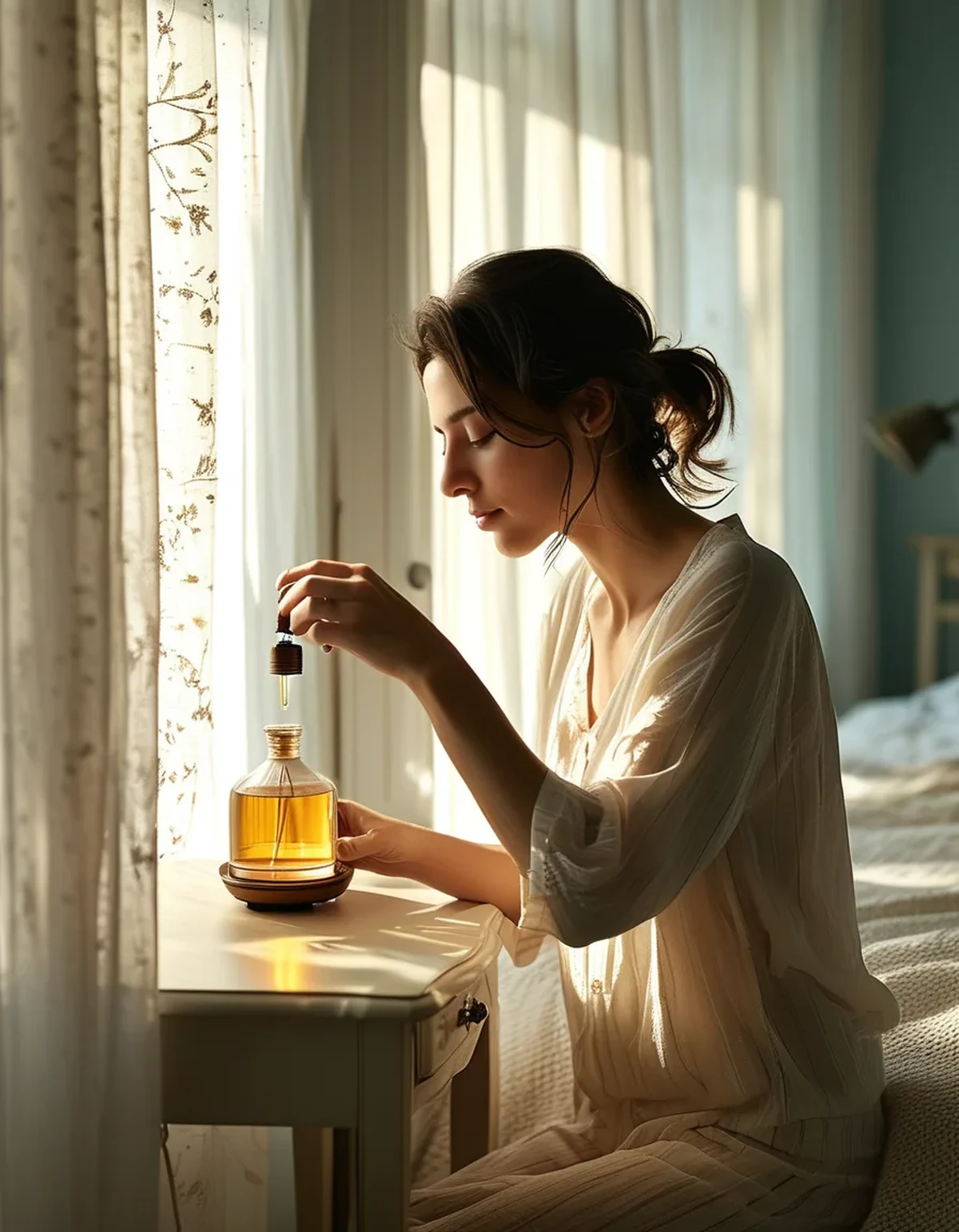
What to use: something grounding and heavier than the morning blend - vetiver, cedarwood, or frankincense, 4 to 5 drops in a diffuser started as soon as you get in.
Why heavier oils here: base notes are less volatile, so they build slowly and last. That suits an evening where you want the scent still present an hour later, rather than a morning where you want a fifteen-minute hit.
A late-summer blend: 3 drops cedarwood, 2 drops bergamot, 1 drop vetiver. The cedarwood reads slightly autumnal without going full winter, which suits the last weeks of August.
The behavioural part matters more than the oil. Starting the diffuser is a two-second action that marks the boundary between the working day and the evening - and it works largely because it is a physical act you perform at a threshold. Pair it with changing clothes and putting your phone somewhere specific and you have a decompression routine that costs almost no time.
Ventilate first if the house has been shut up in the heat. Diffusing into stale warm air is much less pleasant than opening a window for two minutes first.
Ritual 5: The wind-down, 90 minutes before sleep
The timing matters more than the oil, and both matter less than consistency.
What to use: lavender is the most-studied option for sleep-related use, with reasonable if modest evidence. Roman chamomile and sandalwood are alternatives if lavender does not suit you - and a meaningful minority of people find lavender actively unpleasant, which makes it useless for them regardless of the research.
Amount and method: 3 to 4 drops in a diffuser in the bedroom, run for 30 to 45 minutes rather than all night. Continuous overnight diffusion is unnecessary, uses more oil, and adds humidity to a room that may not want it in August.
Timing: start it around 90 minutes before you intend to sleep, alongside dimming lights. The scent becomes part of a cluster of cues rather than a single intervention.
What to expect, honestly: aromatherapy for sleep produces small effects in studies, and the largest part of the benefit is likely the routine itself - a consistent pre-sleep sequence is one of the better-supported sleep behaviours there is. The scent gives the routine a distinctive marker, which makes it easier to keep.
Heat is the bigger variable in August. Room temperature affects sleep considerably more than any oil. Cool the room first, then add the scent.
FAQ: Late-Summer Aromatherapy Questions, Answered
How much essential oil should go in a diffuser?
Most 100 to 200ml diffusers work well with 3 to 5 drops. More is not better - past a certain concentration the scent becomes overwhelming and some people get headaches. Start low.
Is it safe to put essential oils directly on skin?
Most should be diluted in a carrier oil, commonly at 1 to 3 percent for adults. A few, notably lavender and tea tree, are sometimes used neat in small amounts, though dilution is still the safer default. Patch test anything new.
Which oils should be avoided in hot weather or before sun?
Bergamot, lemon, lime, and several other citrus oils are phototoxic and increase sun sensitivity on skin. Diffusing is unaffected. Peppermint near the eyes is unpleasant in any weather.
Are essential oils safe around pets?
Several, including tea tree, peppermint, citrus, and eucalyptus, can be harmful to cats and dogs. Cats are especially sensitive because of how they metabolise certain compounds. Diffuse in ventilated rooms the animal can leave, and check specific oils with a vet.
Do essential oils expire?
Yes. Citrus oils oxidise fastest, often within a year, and oxidised oils are more likely to irritate skin. Store dark bottles away from heat and light, and replace citrus more often than base notes.
TL;DR:
- Attach each scent to an existing transition - waking, leaving, training, returning, winding down
- Citrus and peppermint suit the first half of the day; cedarwood, vetiver, and lavender the second
- Dilute skin applications to around 2 percent, and avoid phototoxic citrus oils on skin before sun
- Diffuse 3 to 5 drops, and run the bedtime diffuser 30 to 45 minutes rather than all night
- The consistency of the ritual does more work than the choice of oil
Late summer is a natural point to reset a routine, partly because the light changes and partly because autumn habits are easier to start now than in the middle of October. Pick two of these rather than five, and they will still be running at Christmas. This is general information, not medical advice.
Keep Reading
This article is for general informational purposes only and is not medical advice. Always consult a qualified health professional for guidance specific to you.