5 Scent Anchors That Make a New Routine Stick Faster
Quick Answer: Olfactory signals reach the amygdala and hippocampus - emotion and memory - with fewer intermediate steps than the other senses, which is why smells trigger memories so vividly and so involuntarily. You can use that deliberately: pair one distinct scent with one specific routine, use it only for that routine, and within a couple of weeks the scent starts acting as a cue that shortens the transition into the task. Five anchor points below, one per part of the day.
September is when everyone tries to rebuild a routine, and most attempts fail at the transition rather than the task. A scent anchor is a small, strange, surprisingly effective way to make the transition cheaper.

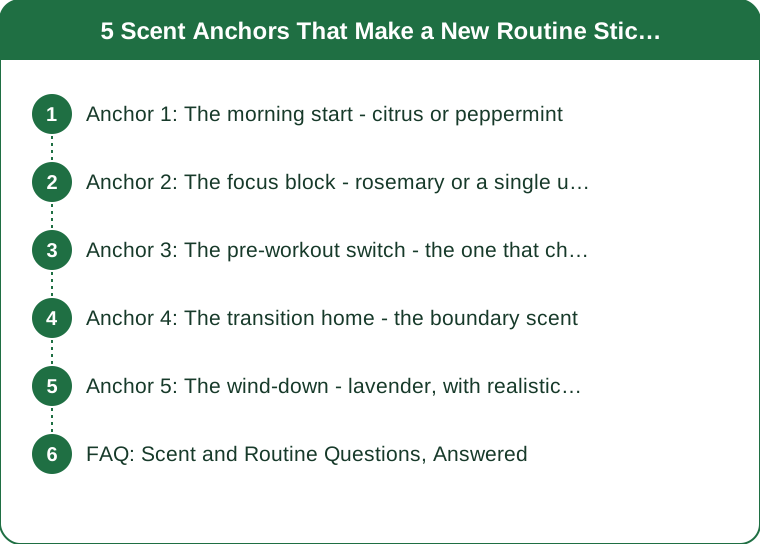
Anchor 1: The morning start - citrus or peppermint
Why this pairing: Citrus and peppermint are the two scents most consistently described as alerting, and small studies on peppermint have looked at effects on alertness and perceived fatigue. The effects reported are generally modest, and part of what you are building here is association rather than pharmacology.
How to use it: Choose one - sweet orange, grapefruit, lemon, or peppermint - and use it only in the first 20 minutes of the day. A diffuser on a timer, two drops on a tissue by the kettle, or a scented hand cream applied at the same moment each morning.
Why exclusivity matters: The anchor works because the scent is not present at other times. Using your morning citrus throughout the day dilutes the association until it means nothing in particular.
Pair it with a fixed physical action. Opening the blinds, filling a water glass, stepping outside for 60 seconds. The scent plus the action becomes the routine’s opening bracket, and after a couple of weeks the smell alone starts pulling the action along with it.
Safety note: Peppermint should not be used around infants and young children, and citrus oils - particularly bergamot - can cause photosensitivity when applied to skin before sun exposure.
Anchor 2: The focus block - rosemary or a single unfamiliar scent
Why this pairing: Rosemary is the most commonly cited scent for cognitive tasks, with some small studies examining effects on memory and alertness. The evidence base is limited and the effect sizes are modest, so treat it as a useful cue rather than a performance enhancer.
How to use it: Diffuse it only during the block of work you most need to protect - one 60 to 90 minute period, not the whole day. The narrower the window, the stronger the association becomes.
The stronger trick is exclusivity, not the specific oil. Any distinct scent that you use exclusively during focused work will start functioning as a cue. Choosing an unfamiliar one is actually an advantage, because it carries no competing associations from the rest of your life.
Consider a portable version for exam or deadline situations. Some people deliberately train a scent during study and then use the same scent during the task itself. The context-dependent memory research behind this is genuinely interesting, though real-world effects are inconsistent and it should not be relied upon.
Keep it faint. A strong scent becomes its own distraction and is a common trigger for headaches, which defeats the purpose entirely.
Anchor 3: The pre-workout switch - the one that changes state
Why this matters most: The hardest part of an evening workout is the transition, not the workout. Anything that marks the boundary between working day and training reduces the cost of crossing it.
How to use it: Apply a specific scent - a rollerball at the wrists, a spritz on a towel, a scented balm - as the first step of getting changed. Eucalyptus and peppermint are common choices because they read as invigorating, but the specific oil matters far less than the consistency.
Attach it to the earliest possible step. Not when you arrive at the gym; when you first stand up to change. You are trying to cue the beginning of the transition, and the beginning is where the resistance sits.
Do not use it on rest days. This is the discipline that keeps the anchor strong, and it is the one people abandon first.
Skip topical oils on skin under compressive clothing if you have any sensitivity - occlusion increases absorption and irritation risk. Always dilute essential oils in a carrier oil before skin application, generally to a 1 to 2 percent concentration for adults.

Anchor 4: The transition home - the boundary scent
Why this pairing: For anyone whose work and home occupy the same rooms, the absence of a commute removes the transition that used to separate them. A scent can substitute for the walk to the car.
How to use it: Pick something distinctly different from your work-hours scent - a warmer, softer profile like cedarwood, vetiver, or a simple candle - and start it at a fixed time that marks the end of the working day.
Change the air as well as the scent. Opening a window for two minutes, even in cool weather, does as much for the sense of transition as the scent does, and the two together are noticeably better than either alone.
This is also the anchor most worth sharing with a household. A candle lit at the same time each evening is a signal everyone can read, which makes it more likely to survive as a habit than a private one.
Practical caution: Never leave a candle unattended, and be aware that scented candles and diffusers can be problematic for people with asthma or scent sensitivity. Unscented plus an open window is a legitimate version of this anchor.
Anchor 5: The wind-down - lavender, with realistic expectations
Why this pairing: Lavender has the largest evidence base of the common oils for relaxation and sleep quality, with several small trials reporting improvements in sleep measures. The effects are modest and the studies are generally small, so the honest framing is a helpful adjunct rather than a treatment.
How to use it: Apply or diffuse it 20 to 30 minutes before you intend to sleep, at the same time each night, and stop using it during the day entirely.
Stack it with the changes that actually drive sleep. Consistent sleep and wake times, dim light in the last hour, and a cool room have far larger effects than any scent. The lavender is the cue that starts the sequence; the sequence is what works.
Give it two weeks before judging. Association takes repetition, and the first few nights tell you nothing.
Safety notes worth knowing: Essential oils are not regulated as medicines, quality varies considerably, and they should never be ingested without professional guidance. Keep them away from children and pets - many oils, including tea tree and several citrus oils, are toxic to cats in particular. If you are pregnant, breastfeeding, asthmatic, or managing a health condition, check with a clinician before regular use.
This is general information, not medical advice.
FAQ: Scent and Routine Questions, Answered
Does aromatherapy actually work?
The evidence for direct physiological effects is modest and the studies are generally small, with lavender for sleep quality having the strongest support. The more reliable mechanism is associative - a scent used exclusively with one routine becomes a cue that makes starting that routine easier.
Which essential oil is best for focus?
Rosemary and peppermint are the most commonly studied for alertness, with modest reported effects. In practice, any distinct scent used exclusively during focused work will function as a cue, and an unfamiliar one has the advantage of carrying no competing associations.
How long before a scent anchor starts working?
Allow about two weeks of consistent daily pairing before evaluating it. The association depends on repetition and on the scent not appearing at other times of day, which is the rule people break first.
Are essential oils safe to use every day?
Generally in diffused form and in small amounts, but they are not regulated as medicines and quality varies. Always dilute to about 1 to 2 percent in a carrier oil for skin, avoid ingestion, keep them away from cats and young children, and check with a clinician if you are pregnant, breastfeeding, or asthmatic.
TL;DR:
- Smell reaches memory and emotion by an unusually direct route, which makes scent an effective cue for starting a routine.
- The mechanism is mostly associative, so exclusivity matters more than which oil you choose - one scent, one routine, nowhere else.
- Anchor the five transitions: morning start, focus block, pre-workout switch, end of the working day, and wind-down.
- Attach each scent to the earliest step of the transition, since that is where the resistance actually sits.
- Give it two weeks, dilute to 1 to 2 percent on skin, keep oils away from cats and young children, and check with a clinician if pregnant, breastfeeding, or asthmatic. This is general information, not medical advice.
The scent is not doing the work. It is making the doorway narrower - and in a September rebuild, the doorway is where most routines actually fail.
Keep Reading
This article is for general informational purposes only and is not medical advice. Always consult a qualified health professional for guidance specific to you.