5 Diffuser Blends That Work in a Small Apartment Without Overwhelming It
Quick Answer: In a small space, use half the drops you’d use in a large room - typically 3 to 5 total rather than 8 to 10 - and run the diffuser intermittently rather than continuously. Choose blends built around one dominant note plus one supporting note; complex four-oil blends become muddy and overwhelming when the air volume is small.
Most diffuser recipes online assume a living room. In a studio or a small one-bedroom, the same recipe saturates the air within minutes, and what should be pleasant becomes the reason you have a headache by evening.
This is general information, not medical advice. Essential oils can affect people with asthma and are not safe around all pets - cats in particular. Ventilate, and keep diffusers out of rooms where pets can’t leave.

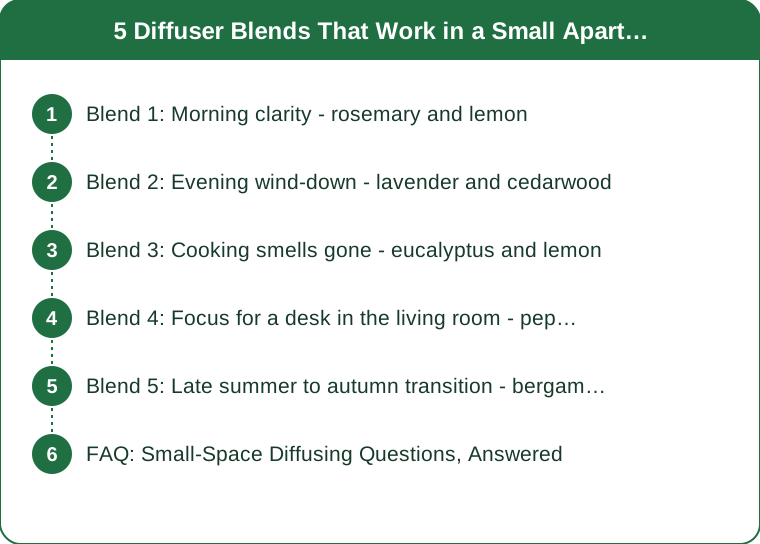
Blend 1: Morning clarity - rosemary and lemon
The recipe: 2 drops rosemary, 2 drops lemon. Run for 20 minutes, then off.
This is the smallest, sharpest blend on the list and the one that does most for a small space, because citrus disperses fast and clears fast. You get the effect without the residue that lingers into the afternoon.
Why it works in a small room: rosemary is potent and easy to overdo - two drops is genuinely enough in under 50 square metres. Lemon lifts it and prevents rosemary’s slightly medicinal edge from dominating.
When to run it: during the first task of the morning, not while you sleep. Twenty minutes is enough for the scent to reach the whole space and begin fading, which is the point - a scent you stop noticing has done its job.
Substitutions: peppermint for rosemary if you prefer something cooler, but drop to 1 drop - peppermint is considerably stronger in a small volume.
A safety note worth stating: citrus oils are phototoxic on skin, meaning they increase sun sensitivity. In a diffuser this doesn’t apply, but don’t move the same blend onto your skin without checking dilution.
Blend 2: Evening wind-down - lavender and cedarwood
The recipe: 3 drops lavender, 1 drop cedarwood. Run for 30 minutes before bed, off before you sleep.
Cedarwood is the quiet workhorse here. Lavender on its own can read as sweet and one-dimensional in a small room, and a single drop of cedarwood gives it a grounded base without adding complexity.
Why the ratio matters: cedarwood is a base note - heavier, slower to disperse, and slower to clear. In a large room you might use it 1:1 with lavender. In a small one, more than one drop lingers into the next morning.
Run it before bed, not during sleep. This is worth being firm about: continuous overnight diffusing in a small bedroom means hours of unventilated exposure, and it’s the most common cause of waking with a headache and blaming the pillow. Thirty minutes before you get in bed scents the room; the scent is still there when you lie down.
If lavender doesn’t work for you - and for a meaningful minority of people it’s stimulating rather than calming - try 2 drops of bergamot with 1 of cedarwood instead.
Blend 3: Cooking smells gone - eucalyptus and lemon
The recipe: 2 drops eucalyptus, 3 drops lemon. Run for 30 minutes with a window cracked.
Small apartments have one specific problem larger homes don’t: the kitchen is in the living room, and last night’s dinner is still present the next morning.
The important part of this one is the window. Diffusing over a cooking smell without ventilating produces a layered smell that’s worse than either alone. Ventilate first for ten minutes, then diffuse. The oils aren’t masking - they’re scenting air that’s already been cleared.
Why eucalyptus: it’s sharp and volatile, cuts through residual grease notes, and disperses quickly rather than settling into fabric. Lemon does the same job at a friendlier pitch.
Where to place the diffuser: away from the kitchen, ideally near where air moves - by an open door rather than in a corner. Corners are where scent pools and where you stop being able to detect it while everyone entering the room can.
Caution: eucalyptus is not appropriate for use around young children, and it’s one of the oils most likely to trigger symptoms in people with asthma. If anyone in the household has either, swap for lemon plus a drop of rosemary.
Blend 4: Focus for a desk in the living room - peppermint and orange
The recipe: 1 drop peppermint, 3 drops sweet orange. Run for 25 minutes at the start of a work block.
Working in the same room where you relax is the defining small-apartment problem, and scent is genuinely useful for it - not because it makes you smarter, but because it marks a boundary that the room’s layout doesn’t.
Why one drop of peppermint: it is by some margin the most overpowering common oil in a small space. One drop is noticeable, two is too much, three will give you a headache within an hour.
Sweet orange rather than lemon because it’s rounder and less sharp, which makes it easier to sit with for a long stretch.
The boundary trick: run this blend only during focused work and never at other times. Within a couple of weeks the association forms and the scent itself becomes part of the transition into work - which is the actual mechanism, not any direct cognitive effect.
A practical note on run time: 25 minutes at the start of a block, not for the whole block. Olfactory adaptation means you stop perceiving a continuous scent within 15-20 minutes anyway, so continuous diffusing costs oil and adds nothing.
Blend 5: Late summer to autumn transition - bergamot, clove, and cedarwood
The recipe: 3 drops bergamot, 1 drop clove, 1 drop cedarwood. Run for 30 minutes.
This is the seasonal one and the most complex on the list - which is why it’s last. Three oils is the practical ceiling in a small room, and this only works because the ratio is heavily weighted toward one.
Why it reads as autumn without being a Christmas candle: clove is the note that signals the season, and a single drop is genuinely enough. Two drops and the whole apartment smells like mulled wine in September. Bergamot keeps it bright and stops it becoming heavy; cedarwood holds it together.
When to use it: the first genuinely cool evening, and then a few times a week rather than daily. Seasonal scents work by being occasional - used every day, they stop registering as seasonal by the second week of October.
Clove safety: clove is a potent oil and a skin irritant at low dilutions. It’s fine in a diffuser at one drop, and it’s one to keep well away from children and pets.
A gentler substitution: if clove is too much, use 1 drop of cinnamon leaf or a drop of ginger, both of which give a similar seasonal signal at lower intensity.
FAQ: Small-Space Diffusing Questions, Answered
How long should a diffuser actually run?
Intermittently - 20 to 30 minutes at a time, with breaks. Most diffusers have an intermittent setting that runs 30 seconds on, 30 off; in a small room that’s genuinely better than continuous. Continuous running in a closed small space is the main cause of headaches.
Why can’t I smell it anymore after ten minutes?
Olfactory adaptation - your nose stops registering a constant scent. This is normal, and it’s why people keep adding drops. Anyone walking in from outside will smell it clearly. Trust the drop count, not your nose.
Is diffusing safe with pets?
Cats lack a liver enzyme needed to metabolise several compounds in essential oils, and tea tree, citrus, peppermint, eucalyptus, and pine are all of concern. Dogs are less sensitive but not immune. Diffuse only in rooms pets can leave freely, and ventilate afterwards.
Do I need a more expensive diffuser for a small room?
No - if anything the opposite. A high-output ultrasonic diffuser designed for a large room will oversaturate a studio. A small, low-output unit with an intermittent setting is the better match.
TL;DR:
- Halve the drop count for a small space - 3 to 5 total, not 8 to 10
- Build blends around one dominant note plus one supporting note; three oils is the ceiling
- Run 20-30 minutes intermittently, never continuously or overnight
- Ventilate before diffusing over cooking smells rather than layering on top
- Peppermint and clove are the two most easily overdone - one drop each, always
- Check pet safety before diffusing anything in a room a cat can’t leave
Small spaces don’t need weaker oils. They need fewer drops, shorter runs, and simpler blends - which happens to make everything last considerably longer too.
Keep Reading
This article is for general informational purposes only and is not medical advice. Always consult a qualified health professional for guidance specific to you.