5 Car Scent Blends for the School Run, the Commute, and the Long Drive
Quick Answer: A car holds roughly 100 cubic feet of air, which is a fraction of a room, so use one third of the drops you would use at home - two to four total, not eight. Match the blend to the drive: peppermint and lemon for the early school run, rosemary and grapefruit for a commute you need to think through, lavender and bergamot for the drive home when you are still wound up, sweet orange and cedarwood for a long highway stretch, and eucalyptus with tea tree for a car that smells like wet gym kit. Never diffuse anything sedating while driving, and always crack a window.
The car is the most under-used scent space most people own and the easiest to get wrong. Five blends below, each matched to a specific drive, with the dosing already corrected for the size of the box.

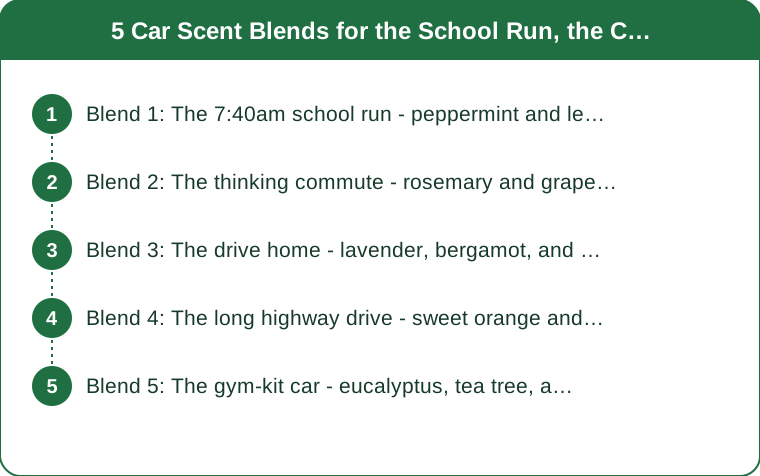
Blend 1: The 7:40am school run - peppermint and lemon
The drive: short, early, and cognitively demanding in a way nobody admits. You are half awake, negotiating a lunchbox dispute, and merging into traffic.
The blend: 2 drops peppermint, 2 drops lemon. That is the whole thing.
Why this pairing: peppermint is the classic alertness scent and its effect is fast and unmistakable in a small space, while lemon lifts the overall impression and cuts the stale-car smell that builds overnight. Both are bright, neither is heavy, and neither lingers offensively for whoever sits in the car next.
How to use it: a vent clip felt pad or a passive wooden diffuser, applied before you start the engine so the initial burst dissipates before anyone gets in. Avoid heated plug-in diffusers - heat degrades citrus oils quickly and makes them smell sharp.
The mistake to avoid: peppermint near young children. Peppermint and eucalyptus are generally not recommended around infants and young children because of the risk of respiratory effects from menthol-type compounds. If you have a baby or toddler in the car, swap the peppermint for sweet orange and open a window instead.
One extra: if the morning is a fight, the scent will not fix it. But a consistent smell attached to a consistent routine becomes a cue over a few weeks, and cues do real work with children.
Blend 2: The thinking commute - rosemary and grapefruit
The drive: 25 to 45 minutes where you are mentally preparing rather than just transporting. The scent job here is sustained alertness without the sharpness of peppermint, which gets tiring over half an hour.
The blend: 2 drops rosemary, 2 drops grapefruit, and 1 drop of frankincense if you want to round it out.
Why this pairing: rosemary is the herb most associated with focus and mental clarity in aromatherapy practice, and grapefruit is the brightest of the citrus family without being as sweet as orange. Together they read as clean and awake rather than cheerful, which suits a working drive.
How to use it: refresh the pad twice a week rather than daily. Scent fatigue is real - you stop consciously noticing a smell within minutes of continuous exposure, and the instinct is to add more drops, which just makes the car overwhelming for passengers who have not adapted.
The mistake to avoid: rosemary is one to be cautious with if you have epilepsy or high blood pressure, and it is generally avoided in pregnancy. Swap to lemon and a drop of black pepper if any of that applies.
And run it on the drive in, not the drive home. Using the same alerting blend at 6pm actively works against the wind-down you need, which is what Blend 3 is for.

Blend 3: The drive home - lavender, bergamot, and a hard rule
The drive: the transition between work and home, where most people arrive still carrying the day.
The blend: 2 drops bergamot, 1 drop lavender. Note the ratio - bergamot leads, lavender supports.
Why this pairing: bergamot is a citrus with a calming reputation rather than a stimulating one, which makes it unusually well suited to this exact drive. A single drop of lavender softens it. The result reads as settled rather than sleepy.
The hard rule: keep lavender minimal and never make it the dominant note while driving. Anything genuinely sedating is a bad idea behind the wheel, and heavy lavender in a warm sealed car is sedating for a meaningful number of people. One drop in a car is not the same as one drop in a bedroom.
Crack a window regardless. Fresh air is doing at least half the work of any car scent blend, and mild drowsiness on a commute home is far more often stale air and rising carbon dioxide than anything else.
How to use it: apply when you get in for the drive home rather than leaving it in the car all day. Oils left on a vent clip through a hot afternoon oxidize and smell noticeably worse by evening.
And build the ritual deliberately. Scent works best as a marker. Same blend, same moment, every evening, and within a fortnight the smell itself starts triggering the transition.
Blend 4: The long highway drive - sweet orange and cedarwood
The drive: two hours or more, where the challenge is monotony rather than alertness at the start.
The blend: 3 drops sweet orange, 1 drop cedarwood.
Why this pairing: sweet orange is the most universally liked oil in the citrus family and the least likely to irritate a passenger, and cedarwood gives it a warm base so it does not disappear in twenty minutes the way pure citrus does. On a long drive, staying power matters more than intensity.
Change the blend at the halfway stop. This is the actual technique. Scent fatigue means the blend you started with is invisible to you by hour two. Bring a second pad with peppermint on it and swap at the rest stop - the change itself is more alerting than any single oil.
Do not rely on scent for drowsiness. No essential oil is a substitute for stopping. Highway drowsiness is a genuine safety issue, and the correct response is a 20-minute stop, not more peppermint. Treat scent as a small comfort tool and nothing more.
The mistake to avoid: over-dosing at the start because you cannot smell it after ten minutes. Everyone else in the car can. Start at four drops total and resist adding more until you have opened the door and come back in with a fresh nose.
And pack for the passengers. Motion sickness is common on long drives, and ginger or peppermint on a tissue held by the affected person is a far better approach than diffusing it for everyone.
Blend 5: The gym-kit car - eucalyptus, tea tree, and actually cleaning it
The drive: any car that has carried wet training kit, sports shoes, or a dog. This is a deodorizing problem, not a scent problem, and treating it as a scent problem is why it never goes away.
The blend: 2 drops eucalyptus, 1 drop tea tree, 1 drop lemon.
Why this pairing: all three have genuinely clean, sharp profiles that read as sanitary rather than perfumed, and tea tree in particular carries an association with cleaning that does psychological work even where the chemistry is modest.
But fix the source first. Essential oils layered over a bacterial smell produce a worse smell, not a better one. Remove the bag, air the boot, vacuum the mats, wipe the rubber seals, and put an open box of bicarbonate of soda under a seat for two days. Then add scent.
Build a kit routine. A cheap mesh laundry bag for wet gear, a dedicated waterproof mat in the boot, and a rule that nothing damp stays in the car overnight solves this permanently. The scent blend is maintenance, not treatment.
The mistake to avoid: eucalyptus and tea tree around children and pets. Both are on the caution list for young children, and tea tree is specifically toxic to cats and dogs if they ingest or heavily inhale it. If you regularly drive a dog anywhere, use lemon and a drop of rosemary instead and rely on ventilation.
General safety notes for all five blends: essential oils are concentrated and a car is a small, hot, enclosed space. Never apply oils directly to dashboard plastics or leather, as they can damage the finish. Ventilate. Do not use oils on skin without proper dilution. Take particular care with children, pregnancy, asthma, and pets, and check specific oils against your own circumstances - this is general information, not medical advice.
TL;DR:
- A car is roughly a third the volume of a room, so use two to four drops total, not eight - the most common error by a wide margin.
- Match the blend to the drive: peppermint and lemon for the early run, rosemary and grapefruit for a thinking commute, bergamot-led for the drive home, sweet orange and cedarwood for the highway, eucalyptus and tea tree for the gym-kit car.
- Never make a sedating oil the dominant note while driving, and always crack a window - stale air causes more drowsiness than scent solves.
- Swap pads at the halfway stop on a long drive; scent fatigue makes a blend invisible to you but not to your passengers.
- Clean the source before scenting it, and check the caution list for children, pregnancy, and pets before choosing an oil.
The car is a small box where a small amount of scent does a lot. Match it to the drive, halve what you think you need, and let the window do the rest.
Keep Reading
This article is for general informational purposes only and is not medical advice. Always consult a qualified health professional for guidance specific to you.