5 Diffuser Blends for Hot, Sticky Evenings
Quick Answer: Humid air holds and carries scent differently than dry air - heavy base notes linger and can feel cloying, while bright top notes disperse faster. For hot evenings, blends built around mint, citrus, and light herbaceous notes read as cooling and clear, while heavy florals, vanilla, and warm spices tend to feel thick. Run shorter diffusion cycles too: 20-30 minutes rather than continuous.
The blend that felt beautiful in February can feel oppressive in August, and it isn’t your imagination. Humid air changes how scent behaves. Here are five blends built for the conditions you’re actually in.
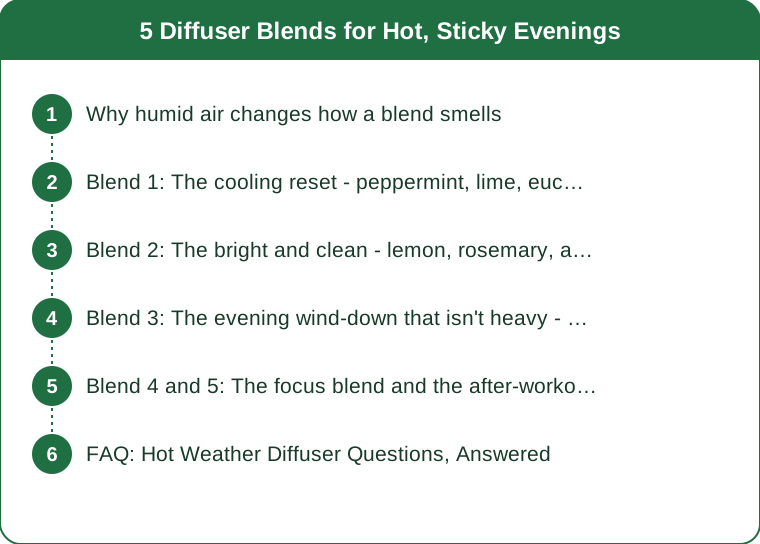
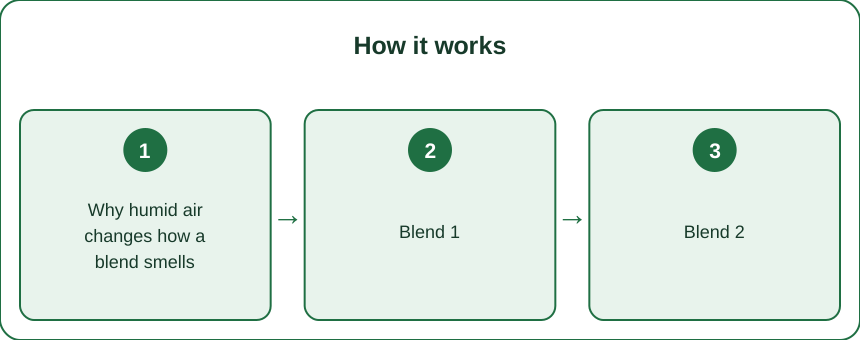
Why humid air changes how a blend smells
Two things happen at once.
Heavier molecules linger longer. Base notes - vanilla, sandalwood, patchouli, benzoin - are larger, slower-evaporating molecules. In humid air, they hang in the room rather than dispersing, which turns a blend that read as warm and comforting into one that feels heavy and close.
Water vapour competes for space. Humid air is already carrying a lot, and scent molecules have to share it. The practical result is that the same amount of oil can feel simultaneously more present and less clear.
Higher temperature also increases evaporation rate, meaning your top notes disperse faster than they would in a cool room. A blend designed with a slow-building top note can feel like it skipped straight to the base.
What this means practically: summer blends should lean top-note heavy, use fewer drops total than you’d use in winter, and run in shorter cycles.
A useful rule: reduce your total drop count by about a third in humid conditions and see whether the blend improves. Most people are simply using too much.
Blend 1: The cooling reset - peppermint, lime, eucalyptus
3 drops peppermint, 2 drops lime, 2 drops eucalyptus.
This is the most directly ‘cooling’ combination available, and it works through an actual mechanism rather than just association: menthol in peppermint activates cold-sensitive receptors in the skin and nasal passages, producing a genuine sensation of coolness independent of temperature.
Best time: early evening, when you’ve come in from heat and want the room to feel like a different environment than outside.
Room: living areas and kitchens. Good ventilation suits this blend.
Watch for: peppermint and eucalyptus are both strong and both have safety considerations - they’re generally advised against around young children and pets, and eucalyptus in particular warrants caution with anyone who has asthma. Check safety guidance for your household before using this one.
Diffusion time: 20 minutes is plenty. This blend is potent and continuous running makes it overwhelming rather than more effective.
Blend 2: The bright and clean - lemon, rosemary, a touch of cedarwood
4 drops lemon, 2 drops rosemary, 1 drop cedarwood.
Citrus reads as clean in a way that suits humid air, where rooms can feel stale. Rosemary adds a herbaceous edge that keeps it from being one-dimensionally sweet, and a single drop of cedarwood gives it just enough grounding without weight.
Note the ratio - the cedarwood is deliberately a single drop. In a winter blend you might use three or four; in humid air, one is enough to do its job without lingering.
Best time: late afternoon, or any time a room feels closed-in.
Room: kitchens and any space that’s been shut up during the day.
Citrus safety note: citrus oils are photosensitising when applied to skin, which is a topical concern rather than a diffusion one. Diffusing is fine; applying lemon oil to skin before sun exposure is not.
Storage note relevant right now: citrus oils oxidise faster than most, and heat accelerates it. Keep them in a cool dark place, not a sunny windowsill, and expect a shorter shelf life than woody oils.
Blend 3: The evening wind-down that isn’t heavy - lavender, bergamot, petitgrain
3 drops lavender, 2 drops bergamot, 2 drops petitgrain.
The standard wind-down blend is lavender with something warm underneath - vanilla, chamomile, or a woody base. In humid heat that combination often feels stifling right when you’re trying to sleep.
This version keeps lavender as the anchor but pairs it with two citrus-adjacent notes instead. Bergamot brings brightness; petitgrain - distilled from bitter orange leaves rather than the peel - adds a green, slightly bitter quality that reads as fresh rather than sweet.
Best time: 60-90 minutes before bed.
Room: bedroom, with the diffuser at least 2 metres from the bed rather than on the bedside table.
Practical note: run it before you get into bed and turn it off, rather than running it overnight. Continuous overnight diffusion in a humid closed room is a lot of moisture into an already-humid space.
On humidity: if your bedroom is already uncomfortably humid, a water-based diffuser adds to that. A reed diffuser or a few drops on a cotton pad near an air vent gives you the scent without the added moisture.
Blend 4 and 5: The focus blend and the after-workout clear-out
Blend 4: Hot-afternoon focus - grapefruit, peppermint, basil
3 drops grapefruit, 2 drops peppermint, 1 drop basil.
The mid-afternoon slump is worse in heat, and this blend is built for it. Grapefruit is the brightest of the citrus oils, peppermint provides the cooling sensation, and a single drop of basil adds a green sharpness that keeps it alert rather than merely pleasant.
Best time: 2-4pm, at a desk or workspace. Diffusion time: 20-30 minutes, not continuous. Scent fatigue - where you stop perceiving a smell you’ve been exposed to continuously - sets in within about 20 minutes, after which you’re diffusing for no benefit.
Blend 5: Post-workout clear-out - tea tree, lemon, eucalyptus
2 drops tea tree, 3 drops lemon, 2 drops eucalyptus.
For the room where damp workout clothes and trainers live. Tea tree is traditionally used for its clean, sharp quality and pairs well with citrus.
Best time: immediately after a workout, in the room where the kit is. Room: home gym, utility room, entryway. Important: this is a scent blend, not a cleaning solution or a substitute for washing kit. Damp fabric left in a humid room needs airflow and washing, not just fragrance over the top of it.
Safety across all blends: tea tree and eucalyptus both carry cautions around pets, particularly cats. If you have animals, check species-specific guidance before diffusing anything, and always diffuse in a room the animal can leave. This is general information, not medical or veterinary advice.
FAQ: Hot Weather Diffuser Questions, Answered
Does a diffuser make a room feel more humid?
Ultrasonic diffusers add a small amount of water vapour to the air. In an already-humid room, a nebulising diffuser (which uses no water) or a reed diffuser avoids adding to it.
Why does my usual blend smell different in summer?
Higher temperatures speed evaporation of top notes and humid air holds base notes longer, which shifts the balance of a blend you know well. Reducing the drop count usually restores it.
How long should I run a diffuser?
20-30 minutes is typically enough. Scent fatigue means you stop perceiving continuous fragrance after about that long, so longer cycles mainly consume oil.
Do essential oils go off faster in summer?
Citrus oils in particular oxidise faster with heat and light exposure. Store all oils in a cool, dark place - not on a sunny shelf.
TL;DR:
- Humid air holds base notes longer and disperses top notes faster, which is why winter blends feel heavy now
- Reduce your total drop count by about a third in humid conditions
- Lean on mint, citrus, and light herbaceous notes; go easy on vanilla, heavy florals, and warm spices
- Run 20-30 minute cycles - scent fatigue means longer does nothing
- Check pet and asthma safety before diffusing peppermint, eucalyptus, or tea tree
This is general information, not medical or veterinary advice.
Keep Reading
This article is for general informational purposes only and is not medical advice. Always consult a qualified health professional for guidance specific to you.