5 Bedtime Scent Rituals for Getting to Sleep Earlier This Autumn
Quick Answer: Scent helps sleep mostly by acting as a conditioned cue rather than as a sedative - the same smell, at the same point in your evening, every night, tells your brain what comes next. Lavender has the most supportive research for perceived sleep quality, but consistency of the ritual matters more than which oil you choose. Five rituals below, each anchored to a specific time in the evening.
The autumn problem is real: darker evenings tend to push bedtimes later rather than earlier, because the day loses its natural closing signal. A scent cue gives you one back.
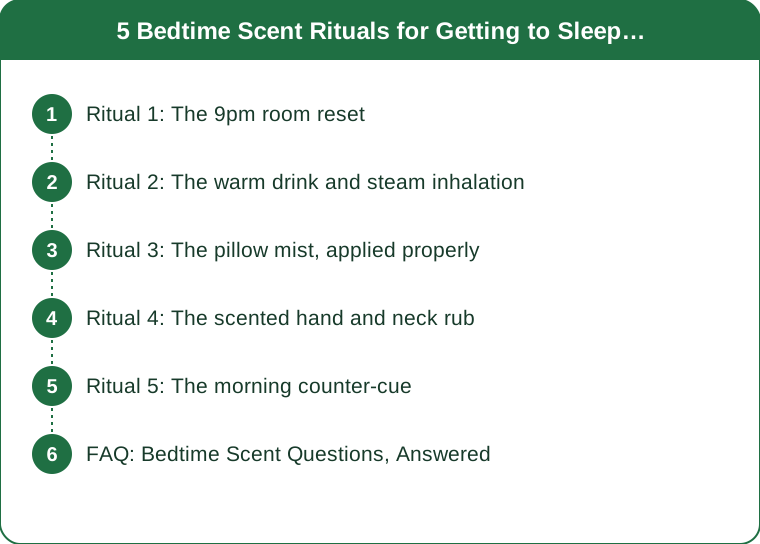
Ritual 1: The 9pm room reset
The earliest cue in the evening, and the one that does the most work.
What it is: at a fixed time - 9pm works for most people with a 10:30 or 11pm bedtime - you do a two-minute reset of the bedroom, and you scent it while you do.
The sequence:
- Open the window for 60 seconds, even in autumn. Cool, fresh air is a strong sleep-supporting input on its own
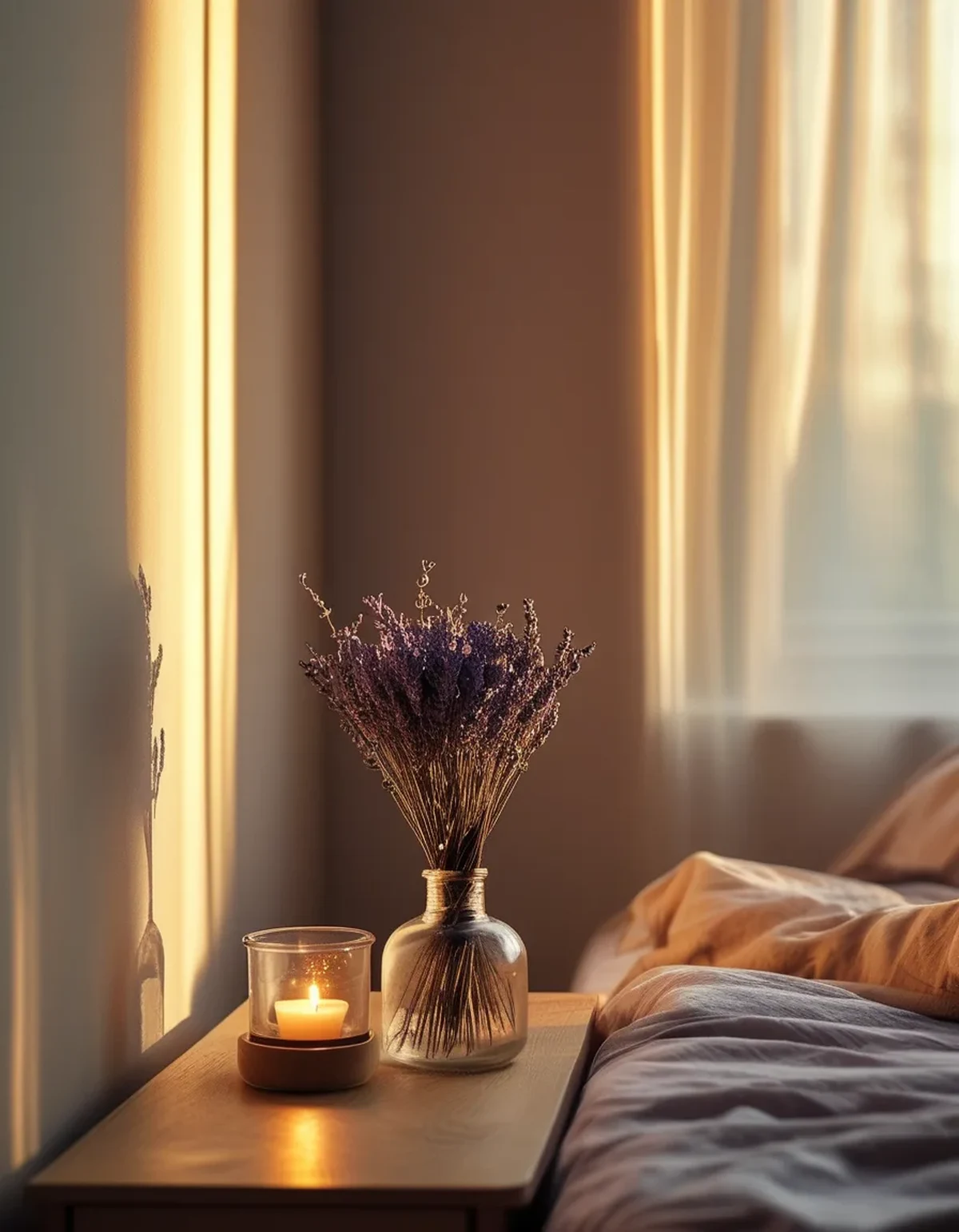
- Two or three drops of lavender on a tissue tucked behind the radiator, or into a diffuser for 20 minutes
- Lamps on, overhead light off
Why it works: you’re building a conditioned association between one smell and the transition into evening. After ten to fourteen days, the smell alone starts triggering the wind-down response, which is the entire point.
The blend, if you want one: 3 drops lavender, 1 drop cedarwood, 1 drop sweet orange. The orange keeps it from smelling medicinal, which matters more than it sounds - people abandon scents they don’t actually enjoy.
Key rule for this one: the time is the active ingredient. A scent at a random hour is just a pleasant smell.
Ritual 2: The warm drink and steam inhalation
The most sensory-rich ritual on this list, and useful if your evenings feel abrupt.
What it is: a caffeine-free warm drink combined with a brief steam inhalation, roughly 45-60 minutes before bed.
The sequence:
- Chamomile, rooibos, or a warm milk - anything without caffeine
- While it cools, fill a mug with hot water and add one drop of lavender or roman chamomile oil. Lean over it, eyes closed, for 60-90 seconds of slow breathing
- Drink the tea sitting somewhere that isn’t your desk or your bed
Why it works: the slow breathing is doing at least as much as the scent. Extended exhales shift you toward the parasympathetic state, and the steam gives you a reason to do it for a full minute rather than ten seconds.
Safety note: never put essential oils directly on skin undiluted, keep your eyes closed over steam, and skip steam inhalation entirely if you have asthma that’s triggered by strong scents.
The trap to avoid: doing this with your phone in your other hand. The ritual is the point; multitasking through it removes the effect entirely.
Ritual 3: The pillow mist, applied properly
The most popular ritual and the most commonly done wrong.
What most people do: spray the pillow heavily just before lying down.
What works better: a light mist on the pillow ten minutes before you get in, so the alcohol or carrier evaporates and what’s left is the scent rather than the wet fabric.
A simple DIY mist: 100ml distilled water, 10ml witch hazel or vodka as a dispersant, 10-15 drops of essential oil total. Shake before each use, because oil and water separate.
Blends worth trying:
- Classic calm: 10 drops lavender, 3 drops roman chamomile
- For a stuffy autumn room: 8 drops lavender, 4 drops eucalyptus, 2 drops cedarwood
- If lavender doesn’t work for you: 8 drops bergamot, 4 drops vetiver. A meaningful minority of people find lavender activating rather than calming, and there’s no reason to persist with it
Test on a hidden corner of the pillowcase first. Some oils stain, and vetiver in particular is dark.
Keep it away from children’s bedding and don’t use it around pets - cats in particular metabolise many essential oil compounds poorly.

Ritual 4: The scented hand and neck rub
The most portable ritual, and the best one for people who travel or share a bedroom with someone who dislikes scent.
What it is: a properly diluted oil applied to pulse points, done as a deliberate two-minute routine rather than a dab.
How to dilute correctly: essential oils should be diluted in a carrier oil - typically 1-2% for adults, which is roughly 6-12 drops per 30ml of carrier. Jojoba, sweet almond, or fractionated coconut all work.
The sequence:
- Warm a small amount between your palms
- Massage into the back of the neck and the tops of the shoulders for a full minute. This is where most people carry evening tension
- Then the hands, finishing with the web between thumb and index finger
- Cup your hands over your nose and take five slow breaths
Why it works: the massage is the larger part of the effect, and the scent makes it a ritual you’ll repeat. Two minutes of deliberate self-massage before bed is a well-established wind-down practice with or without oil.
Never apply undiluted oil to skin. Sensitisation is cumulative and can appear after months of tolerating something fine.
Patch test any new oil on your inner forearm 24 hours before using it near your face.
Ritual 5: The morning counter-cue
The one nobody includes in a bedtime list, and arguably the most effective for actually shifting your bedtime earlier.
What it is: a bright, sharp scent used deliberately in the morning, paired with daylight.
The sequence:
- Within an hour of waking, get outside or by a bright window for ten minutes
- Use a distinctly different scent from your evening one - peppermint, rosemary, grapefruit, or lemon. In the shower, on a tissue, or in a diffuser
- Keep the morning and evening scents completely distinct. That contrast is the whole mechanism
Why it belongs on a sleep list: your bedtime is largely set by your body clock, and the strongest input to your body clock is morning light. If your evenings are drifting later in autumn, morning light is the intervention with the most evidence behind it.
The scent’s role is to make the morning routine something you actually complete, and to sharpen the contrast between morning-mode and evening-mode. Two clearly different sensory environments make the transition between them more legible.
Expect the pairing to take about two weeks before the association sets. Change nothing else during that period so you can tell whether it’s working.
If you have persistent insomnia, sleep that doesn’t improve with routine changes, or you’re regularly exhausted despite adequate time in bed, see a doctor - these rituals are comfort and habit tools, not treatments. This is general information, not medical advice.
FAQ: Bedtime Scent Questions, Answered
Does lavender actually help you sleep?
The research is modest but real, mostly showing improvements in perceived sleep quality rather than in measured sleep architecture. It’s a helpful nudge and a good conditioned cue, not a sedative.
How long should a diffuser run?
20-30 minutes is plenty. Running one all night means the scent stops registering through habituation, and it adds humidity you may not want.
Is it safe around pets?
Many essential oils - tea tree, eucalyptus, citrus, pine, and others - are toxic to cats and can be problematic for dogs. Don’t diffuse in rooms pets can’t leave, and check specific oils with a vet.
What if a scent stops working?
Habituation is normal. Rotate to a different oil for a couple of weeks, then come back. The ritual timing does the heavy lifting, so changing the scent doesn’t reset your progress.
TL;DR:
- Scent works as a timing cue, not a sedative - the fixed hour matters more than the oil
- Mist the pillow ten minutes early, not as you get in
- Dilute to 1-2% in a carrier for anything applied to skin, and patch test first
- Use a sharply different scent in the morning with daylight - that contrast shifts bedtimes
- Check safety around pets and asthma before diffusing anything
Pick one ritual, not five, and do it at the same time for a fortnight. The smell is the reminder; the consistency is what actually moves your bedtime.
Keep Reading
This article is for general informational purposes only and is not medical advice. Always consult a qualified health professional for guidance specific to you.