The Essential Oil Combinations That Cancel Each Other Out
Quick Answer: Stimulating oils (peppermint, citrus) and sedating oils (lavender, chamomile) blended together tend to work against each other rather than combine — your nervous system gets mixed signals instead of a clear one. Pick a lane based on the actual goal.
You blended your favorite calming oil with your favorite energizing oil, hoping for the best of both. Instead it just smells busy and does neither job well. That’s not a fluke — it’s how competing signals work.
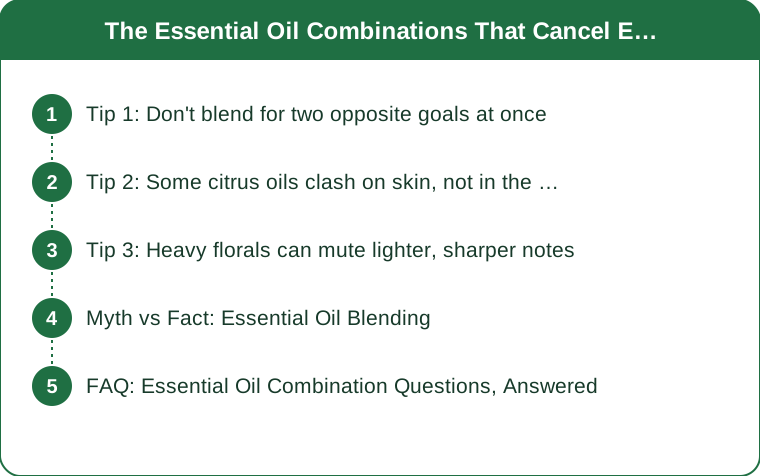
Tip 1: Don’t blend for two opposite goals at once
Lavender (sedating) and peppermint (stimulating) diffused together send the nervous system contradictory cues. If you want alertness and calm focus, reach for rosemary or lemon alone instead of mixing an energizer with a sedative.
Tip 2: Some citrus oils clash on skin, not in the diffuser
In a diffuser, citrus oils blend fine with almost anything. On skin, though, several citrus oils (bergamot, lime, lemon) are phototoxic — they increase sun sensitivity for up to 12 hours after topical application, so pairing them with an outdoor-bound routine is the real mismatch to avoid, not another oil.
Tip 3: Heavy florals can mute lighter, sharper notes
Ylang-ylang and jasmine are strong, heavy florals that tend to dominate a blend. Pairing them with a subtle oil like chamomile usually just buries the chamomile entirely rather than creating balance — pair heavy florals with something equally assertive, like sandalwood, instead.
Myth vs Fact: Essential Oil Blending
Myth: More oils in a blend means more benefits. Fact: Past 3 oils, most blends start working against each other rather than stacking benefits — 2-3 well-chosen oils outperform a 6-oil mix nearly every time.
Myth: If it smells good together, it works well together. Fact: Scent compatibility and physiological effect are different things — two oils can smell lovely together while sending opposite signals to your nervous system.
Myth: Natural oils can’t really ‘cancel out’ anything. Fact: Stimulating and sedating essential oils act on real physiological pathways (alertness vs. parasympathetic response), and combining opposites genuinely blunts both effects.
FAQ: Essential Oil Combination Questions, Answered
What’s a safe rule of thumb for blending oils?
Pick one dominant goal (calm, focus, or energy) and choose 2-3 oils that all support that same goal, rather than mixing oils from opposing categories.
Is lavender safe to combine with citrus oils?
Yes — lavender’s calming effect and citrus’s mood-lifting (not stimulating in the same way as peppermint) profile generally pair well, especially lavender with sweet orange.
How long should I wait between using a stimulating blend and a calming one?
Giving at least 30-60 minutes between an energizing diffuser session and a calming one helps avoid the mixed-signal effect, especially close to bedtime.
TL;DR:
- Don’t blend sedating oils (lavender, chamomile) with stimulating ones (peppermint, citrus) — pick one goal
- Phototoxic citrus oils are a skin-application issue, not a blending issue — check before sun exposure
- Heavy florals like ylang-ylang can mute subtler oils rather than complement them
- 2-3 oils aligned to one goal beats a crowded 6-oil blend
Next blend, ask what single outcome you actually want before reaching for a second bottle.
Keep Reading
This article is for general informational purposes only and is not medical advice. Always consult a qualified health professional for guidance specific to you.