5 Signs Your Essential Oils Aren't Actually Working (and What to Check First)
Quick Answer: Essential oils most often ‘fail’ due to low-quality or diluted oils, incorrect diffusing amounts, scent fatigue from daily overuse, or simply misapplied expectations — checking these 5 things resolves most ‘nothing is happening’ complaints.
You bought the lavender everyone recommends, ran the diffuser every night, and noticed… nothing. Before deciding essential oils just aren’t for you, check these 5 things — most people find the actual issue in the first two.
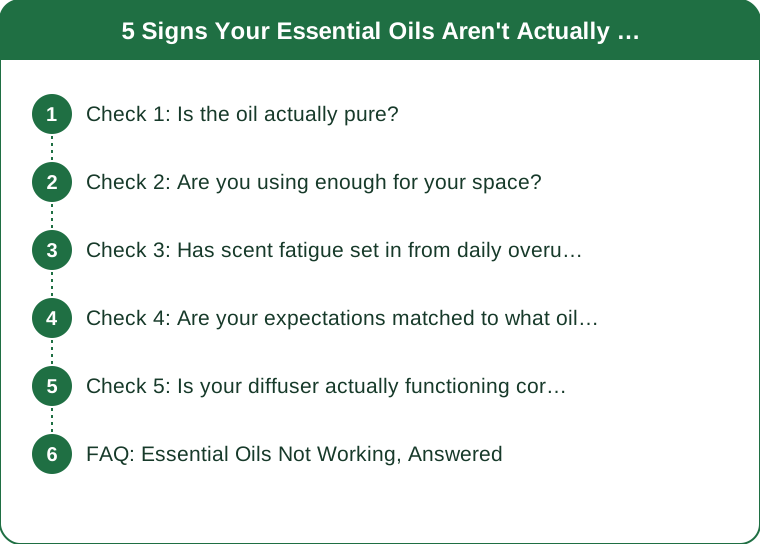
Check 1: Is the oil actually pure?
Many budget essential oils are diluted with carrier oils or synthetic fragrance compounds without clear labeling. Look for a stated botanical name (like Lavandula angustifolia, not just ‘lavender fragrance’) and consider a GC/MS test report if the brand offers one — this single check resolves more ‘not working’ complaints than any other factor.
Check 2: Are you using enough for your space?
A few drops in a large open room simply won’t reach a noticeable concentration. Most diffusers are designed for 3-5 drops per 100ml of water in an average bedroom — using less in a larger space explains a lot of underwhelming results.
Check 3: Has scent fatigue set in from daily overuse?
Your nose adapts to constant exposure to the same scent, sometimes within days, making it genuinely harder to perceive an oil you’ve been diffusing nonstop. Rotating scents every few days, rather than running the same oil continuously, can restore your ability to notice it.

Check 4: Are your expectations matched to what oils can actually do?
Essential oils are generally associated with mood and relaxation support, not the elimination of significant symptoms like anxiety disorders or chronic sleep problems. If the goal is at that level, oils may be a reasonable complement, but expecting them to replace other appropriate care sets up disappointment regardless of oil quality.
Check 5: Is your diffuser actually functioning correctly?
Ultrasonic diffusers can develop mineral buildup or malfunction quietly, reducing output without any obvious sign. If you’ve checked oil quality and quantity and still notice nothing, testing with a fresh diffuser or a different diffusing method (like a reed diffuser) can rule this out.
FAQ: Essential Oils Not Working, Answered
How do I know if my essential oil is actually pure?
Check for the full botanical Latin name on the label, a reasonable price point (extremely cheap lavender is a red flag), and ideally a batch-specific purity test report from the brand.
Can you build a tolerance to essential oil scents?
Scent fatigue from constant exposure is real and can make a familiar oil seem to ‘stop working’ — this is different from a chemical tolerance and resolves with rotation or a short break.
Should essential oils replace medication or therapy?
No — they’re generally best used as a complement to relaxation and mood support, not a replacement for medical or mental health care. This is general information, not medical advice.
TL;DR:
- Diluted or low-quality oil is the single most common cause of ‘not working’
- Use enough for your actual room size — a few drops rarely fills a large space
- Scent fatigue from daily overuse is real; rotate oils every few days
- Match expectations to what oils can realistically support
This is general information, not medical advice — check these 5 things before writing off essential oils entirely.
Keep Reading
This article is for general informational purposes only and is not medical advice. Always consult a qualified health professional for guidance specific to you.